


How to Adopt Agentic Engineering: The Artkai Approach
1. Traditional vs Agentic Engineering: Key Differences and Benefits for Businesses
2. How Artkai Approaches Agentic Engineering: Practices and Cases
3. AI agents integration stages
5. Defining the interface between humans and workflows
6. Designing the agentic workflow
7. Implementation and real delivery
8. Continuous feedback loop and scaling
9. Agentic development technologies
10. Governance and Control in Agentic Engineering
11. Business Impact of Agentic Engineering
The domain of building digital products is now witnessing another prominent transition. After years of scaling with more people, longer timeframes, and searching for ways to optimize workflows within the limitations of the human-only approach, software engineering companies are entering the era of integrating artificial intelligence to boost the value and outcomes they deliver.
Artkai’s clients have already seen the benefits of agentic engineering in practice, as we apply it to digital systems of varying complexity to help our clients leverage modern technology for their business projects. In this article, we share our experience and approach to agentic software development, with execution split between humans and AI agents throughout the workflow. This model enables us to employ AI agents to efficiently handle a growing share of operational work, freeing time and space for human experts to focus on architecture, decision-making, and accountability.
Let’s dive deeper into the best practices for agentic coding we apply in our development process, how they differ from the traditional approach to software engineering, and, most importantly, the business value and impact they deliver to our clients.
Traditional vs Agentic Engineering: Key Differences and Benefits for Businesses
As Gartner predicts, by 2028, an average global Fortune 500 enterprise will have over 150,000 AI agents in use, up from less than 15 in 2025, which will generate significant agent sprawl and management challenges. The challenge for modern organizations, according to Max Goss, Sr. Director Analyst at Gartner, is the “...need to find a balance where they can govern agents and manage sprawl, but also safely empower employees to innovate with these tools”.
So, the shift to agentic engineering is about reconsidering and restructuring how software delivery happens at its core, rather than just adding AI to existing workflows. And that should start from analyzing how traditional engineering models operate and at what point the pressure breaks them, lowering overall efficiency.
Even a highly qualified traditional setup is based on human-driven delivery, which is capacity-limited and sequential. With all the strengths of the expert participants in the process, as work moves from one role to another, each subsequent stage depends on completing the previous one; in this workflow, progress may be slowed by context loss, handoffs, or misalignment. Targeting to scale the output companies scale the team, increasing the levels of growing cost, coordination complexity, and delivery risk.
Agentic engineering introduces a fundamentally different execution model. It operates 24/7 and is not limited by human capacity. That enables continuous execution of tasks across requirements, development, and testing stages of the SDLC. An agentic layer is added to operate across the SDLC, accelerating work, improving efficiency at every stage, and eliminating the wait time when tasks line up. The project's general context is shared among agents and team members while execution transitions to the new levels of continuity and adaptability.
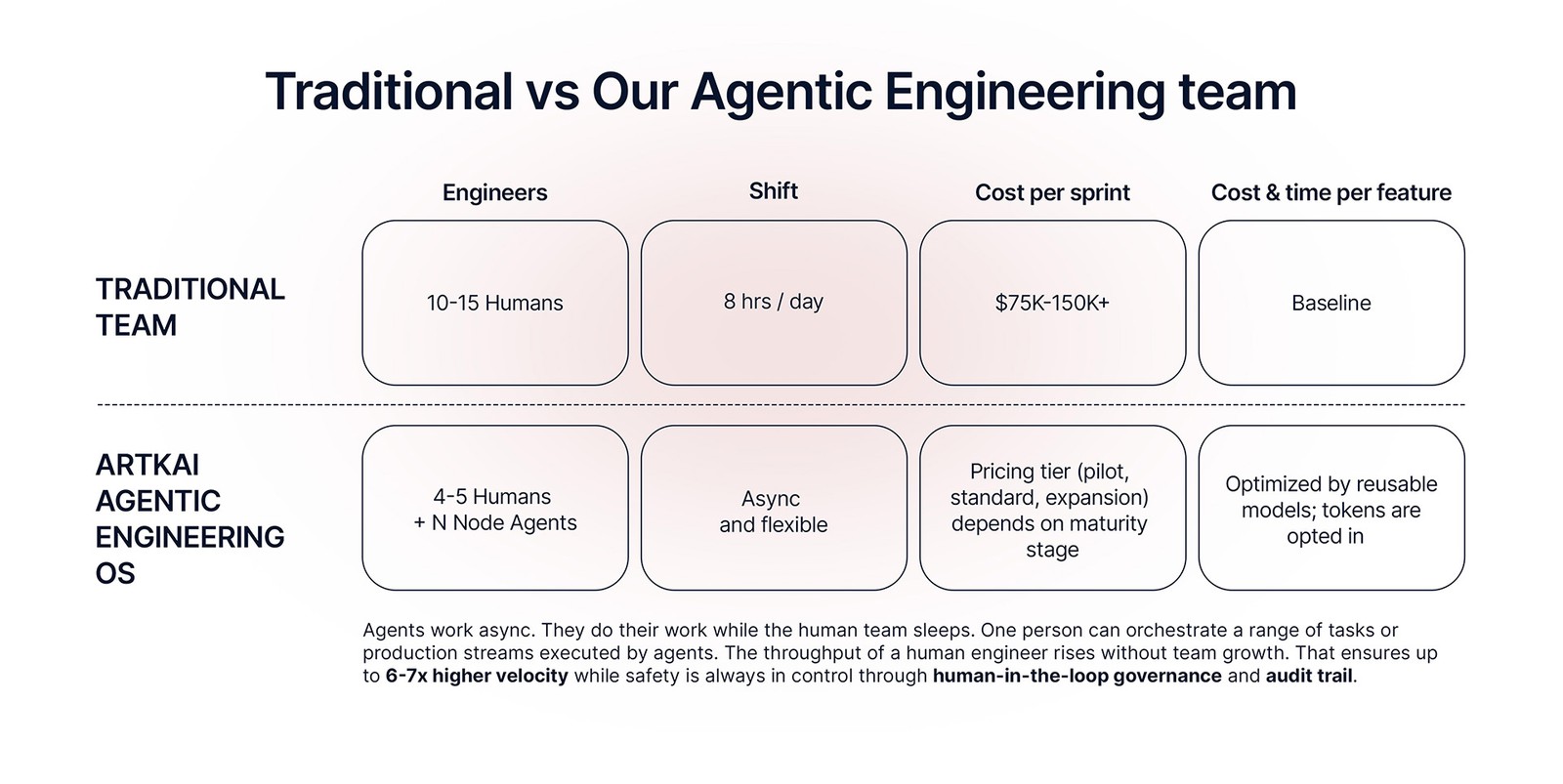
The major point about how integrating agentic AI into SDLC makes things different is not speed, as is often thought. The key difference lies in throughput and workflow coverage. The agentic development model enables work to move forward simultaneously; for example, testing and validation can run in parallel with development. Experienced engineers can get routine time-consuming tasks handled by agents, freeing teams to focus on strategic decisions and non-standard solutions that actually move the product forward.
The traditional process is intricate, as different people working on different tasks have to communicate and check statuses to push the project forward. To execute the task, engineers need to process the description, specify and confirm numerous details with different team members, validate the ideas and outcomes, edit and polish, and so on and so forth.
The agentic engineering approach that Artkai employs provides a toolkit that enables project participants to solve the problems they face by leveraging AI-enabled inputs, feedback, and validation. For example, a product manager who uses artificial intelligence wisely can handle 70% of their work independently, rather than having to specify details again and again and hold multiple meetings that consume precious time. A project manager can independently prepare the near-ready requirements using AI and then validate them with human experts at the final check stage. Tuned properly, this works for most roles engaged in the software development project. With the help of AI systems and skills, participants in the development process can achieve high-level outcomes autonomously, reducing coordination and communication overhead. That speeds up the process massively and enables people to spend their time doing work rather than attending endless meetings.
Obvious business benefits brought by wise, expert integration of agentic software development include:
- Speeding up time-to-market. A process free of waiting and delays between stages shortens the road from idea to production.
- Reaching a higher delivery capacity without linear team growth. Execution is boosted by combining human expertise with agent-driven execution rather than by scaling the team through additional hiring to handle more workload.
- Reducing operational overhead. Less coordination effort and fewer manual handoffs or repetitive tasks enable engineering teams to devote more time to delivering value rather than managing the process.
- Increasing predictability and scalability of delivery systems. Workflows structured and supported by AI agents enable organizations to build a repeatable model that can be scaled across teams and products, including complex, enterprise-scale legacy environments.
So, while traditional engineering optimizes how people work, agentic coding redefines how work gets done.
Aspect | Traditional Engineering | Agentic Engineering |
|---|---|---|
Execution Model | Fully human-driven | Execution by an AI agent, control by a human |
Workflow Structure | One worker's capacity is limited to one or two tasks at a time | One person can orchestrate several tasks or production streams in parallel as they are executed by agents |
Delivery Speed | Limited by team capacity and dependencies | Accelerated through concurrent execution and automation |
Scalability | Requires hiring more people | Agents increase the throughput of a human engineer without linear team growth |
Task Execution | Manual, repetitive work handled by engineers | Operational tasks offloaded to agents |
Bottlenecks | Common between stages (handoffs, approvals, syncs, misalignment) | Fewer friction points and higher performance due to continuous workflow coverage |
Team Focus | Execution-heavy, less time for strategic decisions | Focus on architecture, decisions, and governance |
Agility | Slower response to changes | Faster iteration and minor changes implementations |
Value for money | Scaled with increasing team size, yet scaling the team tends to lead to more bottlenecks, context loss, and delays | Optimized through higher output per team and scaled through a reusable agentic approach |
Quality Control | Dependent on manual review cycles | Continuous validation supported by agents + human oversight |
How Artkai Approaches Agentic Engineering: Practices and Cases
Applying AI in the modern software development process should not be the goal in itself for meeting modern trends. Making agentic development tools work efficiently and deliver business outcomes requires a set of well-analyzed, well-organized strategic decisions rather than simply leveraging isolated automations. That’s why we never start with AI; we set off from the current state of the product, the actual delivery reality, and clarification of the business goals. Based on that, the team identifies the most impactful ways to employ AI in design, development, and testing, and embeds it into the specific project’s SDLC to improve delivery and provide real results aligned with the stakeholders’ vision and objectives.
So, the fundamental stage of the agentic approach to modernizing and reconsidering existing digital solutions is a deep understanding of how the workflow is organized at the current stage, especially where the context loss and bottleneck points are hidden, and which processes are the most effort- and time-consuming. This mapping of the production and delivery states enables us to identify where Artkai’s expertise in AI coding and AI agents will deliver a rapid, clear business impact to our client.
AI agents integration stages
When you hire Artkai experts to boost your business's digital solutions development, the step-by-step approach to agentic workflow integration includes several phases:
- Defining what to automate
- Defining the interface between humans and workflows
- Designing the agentic workflow
- Implementation and real delivery
- Continuous feedback loop and scaling
We will uncover them through practical examples and insights from our projects in which we’ve built enterprise-scale platforms: one for an education and certification platform, another for a healthcare and healthtech communication platform.
In the education and certification product, we utilized agentic engineering to cover the full delivery cycle from idea to testing.
Here, the agentic-first approach helps shape and validate ideas, confirm use cases, and prepare requirements even before the team gets involved. Then, the idea turns into a detailed product requirements document, and a network of agents reviews it to improve quality upfront, reducing the need for early refinement. Once aligned, the workflow supports decomposition and automatically generates Jira tickets.
The same approach was extended into delivery and QA. Finely tuned agents support code generation, test case creation, and test automation. The client gets a more scalable end-to-end process that considerably reduces manual effort, increases velocity, and improves consistency from discovery to delivery.
A healthcare communication platform is a large, heavily used ecosystem that unites several digital products for web and mobile, with a large team, a broad customer base of clinics using its software, and a well-established business focused on providing technical services for communication and information in healthcare systems, hospitals, and clinics.
One of the challenges the client faced was connected to quality. Their products were built in different ways and had to be assessed against more than 30 different criteria. Traditional grooming and documentation were resource-intensive and time-consuming.
To solve the problem, we introduced an agentic-first mechanism that documented legacy systems by reviewing applications, asking targeted questions, and employing reverse-engineering product logic. Gathering and validating requirements, agents gave teams a clear vision of the platform’s architecture. This was also extended to QA: agents were used to turn validated requirements into structured test cases.
The solution resulted in significantly reduced manual effort, faster and better-structured understanding of complex systems, and a more scalable approach to product quality.
Let’s look more closely at how it works at different stages
Defining what to automate
The existing workflows in digital product building and updating are broken down into atomic processes. This enables software engineers to identify where AI agents generate the most value, with a major focus on repetitive, execution-heavy tasks that create unnecessary friction and slow down delivery. Many businesses would like to benefit from artificial intelligence capabilities, but the challenges with requirements and the lack of relevant expertise make it hard for them to implement automation and integrate AI into the development workflow. At this stage, we communicate with the client’s team, gather information about the product and business goals, and visualize this in a feature flow diagram.
Case studies: For an education and certification platform, as the product scaled, the client encountered a growing delivery challenge. Product stakeholders, business analysts, and developers had to process a lot of feature-related feedback and requirements. However, the information that the development team got was often fragmented and inconsistent. It was difficult to translate it into actionable tasks. Unnecessary clarification loops were created, which slowed the transition from analysis to implementation. Developers needed more structured inputs to understand what context was missing, what they had to build, and which details were critical for the next delivery stage.
To solve this, we introduced an agentic workflow that structured incoming requirements before they reached developers. The agents checked if the information followed the required format, then validated it against predefined quality gates, and highlighted details that were missing or unclear. Analysts could provide more complete inputs and provide developers with a straightforward, development-ready foundation for implementation.
All that resulted in reduced ambiguity in requirements. The solution improved the quality of analyst-to-developer handoffs and created a repeatable process for turning business feedback into product updates. This meant that our client could benefit from smoother delivery, fewer communication loops, and a scalable foundation for future platform development.
Defining the interface between humans and workflows
At this stage, we build a comprehensive approach to how teams interact with agentic systems within a strong, effective human-in-the-loop framework and how it integrates into the existing environment, defining ownership boundaries, validation points, and decision-making layers. This way, we ensure that AI agents speed up and optimize execution, while human experts retain full control over outcomes at all stages.
Case studies: The product team of the education and certification platform already relied on Confluence as their core space for documentation, requirements, and team collaboration. Artkai integrated the agentic layer directly into Confluence, rather than introducing a separate environment or forcing the team to change its existing workflow. This enabled team members to interact with the agent in a familiar environment and keep the workflow where product context already lived. The agent helped process and structure information without disrupting the team’s existing collaboration model.
As a result, the client gained a more efficient workflow and avoided the friction of tool migration or process redesign. The team could continue to use Confluence effectively as its source of product knowledge and benefit from clearer-cut requirements, faster context processing, and a more consistent information flow between analysts and developers.
With the healthcare communication platform, QA engineers could use TestRail and Cursor to complete their tasks. To accelerate the process in established, effective environments, they developed their own agents that helped them explore existing legacy applications and quickly adapt the findings for testing in the toolset that was convenient for them.
As a result, the agentic solutions enabled engineers to push comprehensive testing to a new level of speed, a considerable advantage for such complex, multilayered products. That provided clients with shorter iterations of previously time-consuming processes as well as increased the speed of removing problematic points or implementing new features to enhance the customer experience and grow more strongly in the market.
Designing the agentic workflow
This is the stage when the customized workflow is built up, tailored to your product, tools, and infrastructure. Here, we define how tasks are orchestrated, how AI agents should operate across stages, and how execution proceeds continuously rather than sequentially. We design the agentic workflow to leverage the core components of AI agents, for example, their ability to use tools for interactions with their environment or their reasoning and memory capacity to tune adaptive, self-evolving processes serving specific requirements and goals.
Case studies: Across the presented projects, Artkai used agentic workflows to support varying levels of QA automation. They were based on the product context, testing scope, and the maturity of the existing test infrastructure. In some cases, agents helped engineers generate and refine test cases for manual validation. In others, they supported automated testing flows by preparing structured scenarios, identifying gaps, and enabling the team to cover repetitive validation tasks more efficiently.
This flexible approach allowed Artkai’s engineers to choose the most practical level of automation for each case instead of applying a one-size-fits-all approach.
Implementation and real delivery
Artkai software engineers embed with your team to integrate agentic workflows directly into your environment and start delivering work through this system. This way, we ensure that the workflow is tested and fine-tuned under actual delivery conditions.
Case studies: For the mentioned complex legacy platforms, the challenge at this stage stemmed from scale, accumulated product logic, and fragmented operational knowledge. Over time, the products had grown into large, data-heavy ecosystems. Documentation, workflows, test cases, and business rules were spread across multiple tools and processes. So, even experienced engineers had to spend significant time gathering context before they could confidently step in to update, test, or extend the product.
This led to a bottleneck in QA and delivery. The process relied heavily on individual expertise. That slowed delivery, hindered onboarding, and made it harder to scale quality. Test coverage was inconsistent, automation was limited, and understanding legacy behavior required manual exploration of the product.
Addressing the issues, Artkai implemented two types of agentic solutions.
The first included centralized, cross-system agents hosted on servers and available to the broader project team. They worked with shared project context, supported more complex workflows, and helped standardize repetitive operations across the delivery process. For complex pipelines, Artkai mainly used LangGraph, while LangChain was applied for simpler agentic flows.
The second type included personal agents that individual engineers used for more specific tasks. For example, QA engineers used agents alongside TestRail and Cursor to explore legacy functionality, generate and refine test cases, and integrate findings into their testing workflows.
As a result, the manual effort required to understand and validate complex legacy functionality was seriously reduced. The client gained a more repeatable and scalable delivery model. It preserved critical context, testing workflows became more consistent, and future modernization work could move faster without the loss of control or quality.
Continuous feedback loop and scaling
A feedback-driven system is set to let team input, real usage, and delivery metrics keep improving outputs. Based on that, the system is growing and being enhanced to get more efficient as automation expands and workflows mature.
Case studies: For the mentioned platforms, Artkai treated agentic workflows as living systems rather than one-time automation setups. After implementation, agents were continuously refined based on real user feedback, delivery observations, and the quality of outputs produced in actual project conditions.
On the education platform, a blind spot was found in how error-handling information was collected and transferred to developers. Some critical details were either inconsistent or missing from the development-ready requirements. That posed risks to implementation quality. Artkai addressed the issue by adding a specific requirement to the agentic workflow. We ensured that error-handling information was captured, structured, and made visible before development started.
Another feedback loop emerged when users noticed that the agent's scanning and recognition of video content did not accurately capture all necessary details. This feedback led to refining the agent's rules and requirements. That improved its ability to process content in a way that better matched the team's needs.
Agentic development technologies
Stepping further from single tools or models, agentic engineering is a coordinated system of technologies that work together in the agentic SDLC.
To help businesses use AI agents systematically and effectively in complex legacy systems, Artkai leverages different tools and technologies:
- LLM-based agents. They handle context processing and task execution 24/7, enabling continuous workflows controlled by experts but not limited by human capacity.
- Orchestration frameworks. Coordinating task distribution and workflow tuning, they boost the throughput of each human expert by effectively orchestrating multiple tasks and workflows.
- Code generation and validation pipelines. They enable faster coverage of repetitive, standardized tasks and the validation of ideas and solutions without compromising quality.
- Automated QA and testing flows. They significantly reduce time-to-market and accelerate the implementation of new features aligned with actual users’ needs and feedback.
- Integrations with tools like Jira, Slack, Confluence, and CI/CD systems. These enable massively increased efficiency and velocity without disrupting existing environments, and let product teams continue working with tools that are convenient for them.
- Different types of agentic solutions. Depending on the specific goals, our engineers create server-hosted, cross-system agents or personal agents that present the most practical solution for the particular issue or workflow.
All components form a unified execution layer that conveys context across systems and enables continuous task progression. One more essential aspect to stress is that the AI agents don’t replace the existing toolset; instead, they operate within your digital product's existing environment, enhancing and accelerating workflows rather than disrupting them. Also, an architectural approach is chosen for each case to precisely meet the specific needs and goals.
Governance and Control in Agentic Engineering
As a software engineering team with a massive portfolio of digital products, including 50+ projects in heavily regulated sectors like finance and healthcare, Artkai is deeply aware of the importance of security and compliance for both enterprise systems and startups entering the market. And that is one of the core concerns when companies consider integrating artificial intelligence into their work and business processes. It’s critical for businesses to ensure that quality, accountability, and security standards are met when synthetic participants join the process of building software. That’s why, at Artkai, governance is deeply rooted in every agentic development system we build, and human experts play the first fiddle.
The choice of agentic solutions depends on how the product handles data. For example, the self-hosted agent approach is preferred for enterprise ecosystems that consider it critical to keep data within their network perimeter. Another case, which is the most popular at the moment, is when companies are open to using AI products with SLC-2, meaning that, for their objectives, AI platforms such as OpenAI or Ontopic are quite suitable.
One more thing clients expect is visibility into and monitoring of usage and costs. In long-term use, we provide them with information, for example, how many tokens were used and which specific requests users made, so the client can feel fully in control, track trends in their product usage, and govern data usage.
The next issue to address is access to the data. For example, in the case of the healthcare communication platform, the company was open to providing the agentic models with access to the data in Confluence via an API, as the data there was product-focused and didn’t contain any confidential information. However, they didn’t want to grant access to SharePoint, as the data there was more sensitive and required higher security. We handle such situations at the level of access tokens: when a token is generated, we set its scopes and restrict access where needed. So, we cover data security based on clients' specific requirements.
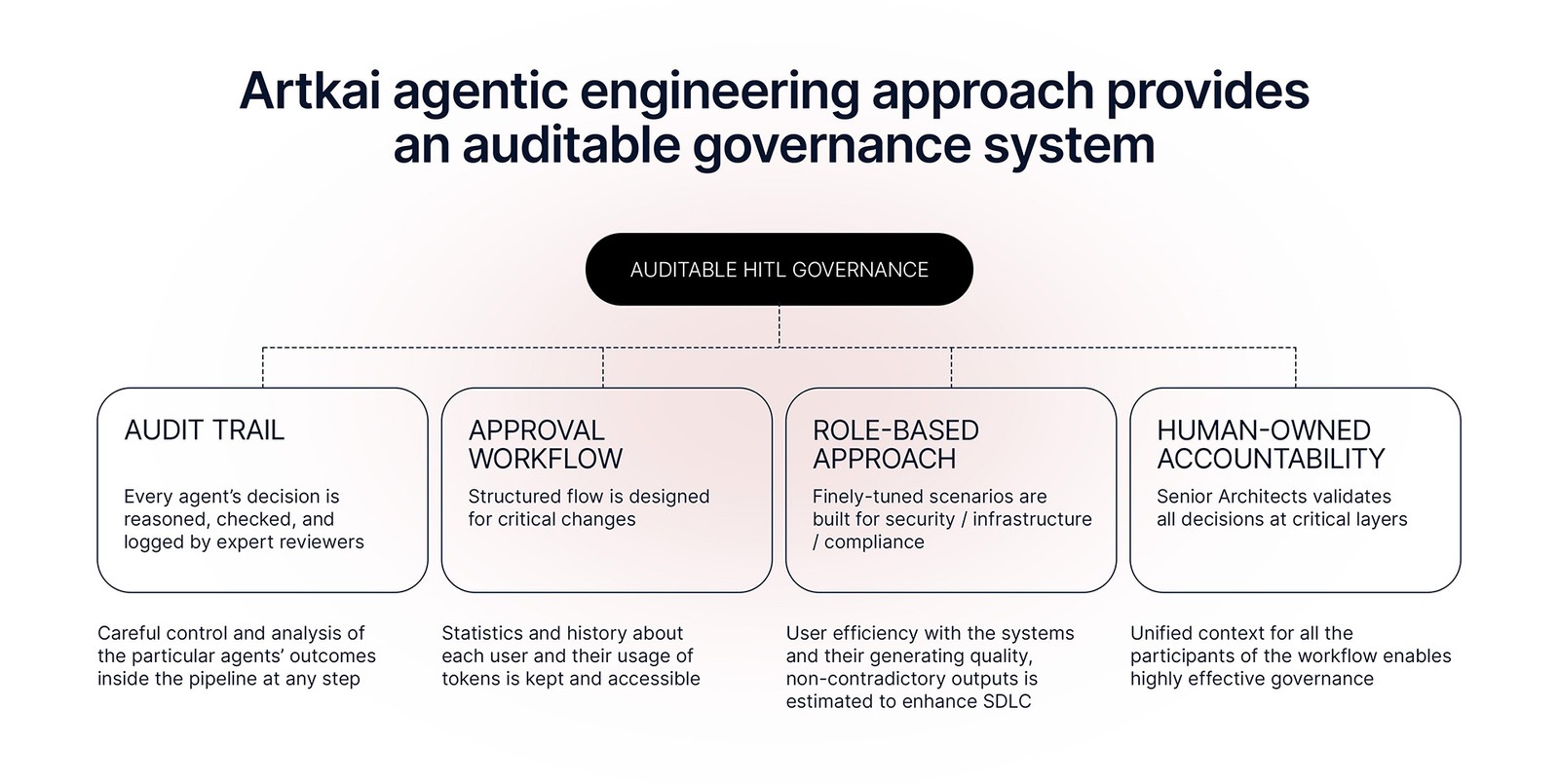
Governance, compliance, and security aspects of the agentic approach are usually solved by design in Artkai. The human-in-the-loop system is designed at the level of the pipeline: when the agentic flows are designed, with a clear understanding of what is automated and approved by the agent, and what is approved only by the human expert to allow the pipeline to proceed.
In particular, our approach to governance and security in leveraging AI agents for development includes:
- Clear architectural guardrails. Critical decision points that require human validation are defined by experienced engineers. That ensures agents never operate unsupervised, as every AI action is framed within a set of rules and constraints, including security protocols and compliance requirements. So everything moves forward with thorough human oversight at key layers.
- Accountability human-owned by design. Agents execute repetitive tasks and standardized parts of workflows, but it’s humans who retain product vision, final judgment, and governance responsibilities. This way, we ensure legal and regulatory alignment and provide confidence that agentic delivery enhances performance and efficiency without introducing risk.
- Carefully controlled integration with the client’s existing tools and processes. This layer of governance ensures that agents operate as effective co-pilots rather than isolated pilots. They are integrated to work within your Jira, Confluence, Rally, Slack, or SharePoint environments with respect to existing workflows, approval gates, and access controls. This helps build solid, long-term traceability, auditability, and maintainability.
- Iterative governance. When Artkai software engineers embed the agentic layer into clients’ product SDLC, outcomes are continuously monitored and tracked to refine rules and adjust guardrails accordingly for efficient, transparent, and business-driven delivery. We build a flexible living system evolving with your product, team, and technology stack.
As a result, by collaborating with Artkai to obtain agentic engineering services, our clients obtain a delivery system that can grow and scale efficiency without compromising control, security, or accountability. Artificial intelligence capabilities expand capacity, while experts and leaders can focus on strategy, vision, and non-standard aspects.
Business Impact of Agentic Engineering
Our practical experience, as well as global statistics, show that the business impact of agentic engineering is clear and growing as the approach is refined and technology evolves. The shift from manual coding to mobilizing and masterminding so-called agent factories accelerates software development, makes it cost-effective, and supports achieving higher levels of quality and non-standard solutions. One of the biggest benefits clients get is that the agentic approach enables them to obtain a clearly defined, well-described production process that is automated as much as possible. What’s more, they get quality gates at the points where they didn’t have them before. For example, in addition to code quality and test checks, they get a quality check on how well the test cases or requirements are written. Agentic solutions enable us to measure quality at levels previously unattainable, thereby enhancing the pipeline and improving outcomes.
In various business domains and for products of different complexity, the agentic engineering approach by Artkai creates impact across four levels:
1. Delivery performance
- Shorter cycles from requirements to release
- Async, flexible work shifts not limited by human-only capacity
- Faster validation and testing
- Fewer delays between SDLC stages
2. Quality and governance
- More consistent requirements
- Continuous validation
- Clearer ownership and approval points
- Efficient human-in-the-loop systems meeting specific business goals
3. Team productivity
- Faster onboarding through structured context
- Increased cross-team velocity
- Higher throughput without linear team expansion
- Quicker completion of repetitive operational tasks
4. Long-term scalability
- Reusable workflows
- Repeatable delivery infrastructure
- A system that remains effective and brings value after Artkai’s engagement ends
In tangible effects, it results in:
- up to 30–40% faster delivery cycles
- considerable reduction in manual processes
- building a reliable, long-term working base that can be used for further development
- lower cost per feature and higher value for money without scaling teams
Final Thoughts
In this article, we introduce our approach to integrating agents into software development and show that agentic AI in the SDLC now goes far beyond experiments. Instead, it helps us fundamentally and strategically redesign software delivery so that our clients can achieve greater efficiency and measurable outcomes.
Our human expert team embeds artificial intelligence effectively, with clear governance, and integrates it successfully into existing workflows, helping companies leverage AI agents to build production-ready, future-proof delivery systems. The real advantage for businesses is that we create a repeatable system that continues to work even after our engagement ends.
Are you considering transforming your digital product workflow with agentic engineering? Contact Artkai and let’s schedule a 30-minute assessment to discuss a clear plan aligned with your objectives.
Clients and Results






Schedule your free consultation
Don't miss this opportunity to explore the best path for your product. We are ready to delve into the specifics of your project, providing you with expert insights and optimal solutions.
Book your free sessionRead More
Explore articles from Artkai - we have lots of stories to tell
Join us to do the best work of your life
Together we advance the human experience through design.