



How to Hire Top-Tier Fintech Developers for Your Next Project
Hiring fintech software developers to build or modernize a digital product is a challenge for business stakeholders. It’s not enough to find a team well-versed in design and coding: creating an efficient, future-proof fintech app demands that the vendor understands compliance standards, security and data protection issues, and the logic of financial operations. If you're evaluating fintech development partners, here’s the guide on how to choose the right one, and what to expect when working with a team like Artkai.
Being an experienced fintech software development company with 50+ implemented projects of different complexity in the domain, we’d like to share with you a set of tips and strategies on how to hire fintech software developers in 2026. In the guide below, let’s explore essential criteria, collaboration models, and actionable steps to find financial software developers who perfectly fit your business objectives and approaches.
Key Criteria To Define Top-Level Fintech Developers
Beyond general coding expertise and a focus on building a positive user experience, it’s important to ensure the fintech application developers you consider have deep domain expertise, a business-oriented mindset, and specific knowledge of financial technology. So, when hiring fintech software developers, make sure the team meets a set of criteria that are critical to building effective and secure digital products in this sphere.
Our experience shows that the essential criteria are as follows.
- Expertise in fintech engineering and modernization: hire dedicated fintech developers with a proven track record in building and upgrading fintech software solutions and real experience in integrating modern technology such as AI, data analytics, blockchain, and the like.
- Compliance understanding: during the hiring process, assess the vendor’s familiarity with KYC, AML, PCI DSS, PSD2, GDPR, and other financial regulations. Knowing how to embed compliance into the UX and backend of the new or modernized fintech app makes a huge contribution to its future success.
- Security-first development: in such a sensitive sphere as finance, security is a top priority, so check out the fintech development team's practical experience with advanced data encryption, secure architecture, penetration testing, and adherence to standards such as OWASP and ISO 27001.
- Domain-specific UX knowledge: fintech apps involve a lot of specific features and peculiarities, so it’s important to ensure that the fintech development team of your choice knows how to create trustworthy and intuitive interfaces with user experience built around financial logic, onboarding flows, statistics, and dashboards.
- Sub-industry competence: understanding of neobanking, wealthtech, insurtech, lending, and related sub-domains of the financial technology industry means that the development team is aware of nuances and able to find the most effective approach for your specific business goals and conditions.
- Robust data integration: top fintech development companies know how to connect payment gateways, market data, and credit bureaus securely and efficiently.
- Agile and transparent collaboration: whether building a fintech MVP or modernizing an enterprise-level platform, the best fintech developers provide streamlined processes, clear communication, and visibility across all development stages.
- Balanced cost-value ratio: transparent pricing offered by the vendor you consider should reflect the impact of both project complexity and long-term ROI.
- Long-term support, iteration, and maintenance: as fintech products constantly evolve and the sphere is really volatile, the readiness of the fintech development company to strategically support its continuous optimization, maintenance, and scalability is another essential point to take into account.
- Favorable location and IP protection: ensure the fintech development vendor meets requirements for operational alignment, IP security, and full legal transparency.
Recently, we published an article that describes all the mentioned criteria in detail and shares practical insights. If you are interested in diving deeper, check our practical guide on how to choose the right fintech development partner.
Collaboration Models When You Hire Remote Fintech Developers
Another important aspect to consider is choosing the collaboration model that best aligns the fintech development company you hire with your business objectives and vision in the most efficient way.
The popular and well-established collaboration models for developing fintech solutions include outsourcing, dedicated teams, and staff augmentation.
Outsourcing fintech development is a model that involves partnering with an external service provider to take care of your project end-to-end. This approach is perfect for businesses that strive to obtain fast, secure, and compliant solutions for their fintech product without building a full in-house development team. Top fintech outsourcing companies have diverse skill sets and domain knowledge, bringing their experience in regulated environments, complex integrations, and multi-platform deployments, and provide clients with fintech solutions that meet industry standards and users’ expectations.
In the case of outsourcing, you hire fintech software developers from a company that employs its own team and resources to cover a specific set of tasks to build your financial app. So, it gives you, as a stakeholder, the opportunity to focus on business and strategic aspects and delegate the technical part to the vendor, which provides you with access to specialized expertise and skill sets your company may lack in its internal workforce.
A dedicated team presents an approach when you get a fintech-oriented squad of specialists that dives into your project exclusively. In line with the roadmap for building or modernizing your fintech app, the dedicated software development team can include specialists such as frontend and backend developers, UI/UX designers, QA engineers, DevOps specialists, and other professionals who align with the project's specific requirements. Based on our hands-on experience, this option is especially effective for complex or highly regulated products. In them, the fintech domain expertise, long-term scalability, compliance, and iterative development have a critical impact on the digital product's success.
Staff augmentation is another popular approach to hiring fintech developers. It enables your business to add skilled and experienced fintech experts to your existing team for a specific period and according to the specific objectives. This mode is highly effective, for example, when you need specialized skills to ensure compliance, conduct security audits, or integrate complex banking and payment systems into your fintech application. The augmented team operates within the client’s company processes, which provides a foundation for seamless collaboration while the client maintains control over sensitive financial data and project priorities.
Model | What It Is | Best For | Key Advantages | Limitations |
|---|---|---|---|---|
Full Outsourcing | Vendor handles the entire fintech product lifecycle — discovery, design, development, QA, security, deployment. | • No internal tech team | • Access to full fintech expertise | • Less daily control |
Dedicated Development Team | A long-term, cross-functional fintech team working exclusively on your product. | • Long-term development | • Full focus on your product | • Requires ongoing client involvement |
Staff Augmentation | Adding external fintech specialists to strengthen your in-house team. | • Closing skill gaps | • Full control | • Full management on the client side |
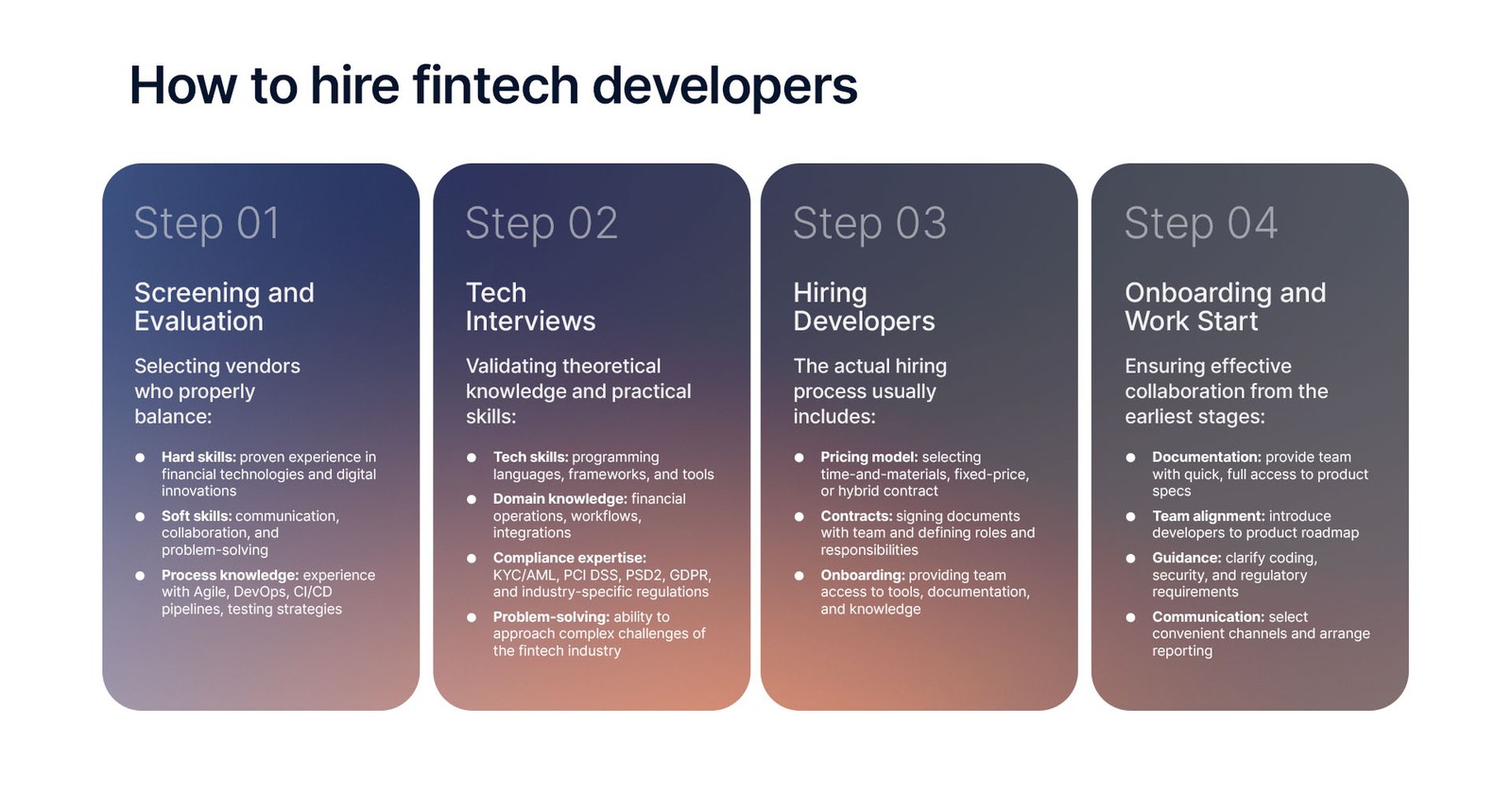
4 Key Steps of Hiring Fintech Developers
Based on our diverse practical cases of building fintech apps and platforms, let’s define four primary stages of hiring a fintech development team for your business project, highlighting aspects that are critical to consider and questions you are suggested to ask a potential vendor to screen their expertise.
Step 1: Screening and Evaluation
At the first stage of the hiring process for your fintech software, you aim to filter vendors and select those who properly balance deep technical expertise and a skill set with domain-specific knowledge and experience. Thorough screening helps you evaluate candidates and avoid mismatches. It ensures your choice falls on fintech developers with the relevant mindset, process maturity, and efficient development approach.
Focus areas:
- Hard skills: Aim to hire fintech developers with real cases and proven experience in modern financial technologies and digital innovations. These may include digital banking, payment processing, AI for financial analytics, real-time data pipelines, blockchain, and the like. Find out whether the team includes fintech programmers with the technical skills and practical experience in programming languages required to build reliable products in the financial industry. Whether you want to build an MVP to quickly validate your idea in the market or renovate the existing well-established financial application, check that the potential vendor’s fintech app developers know how to deal with scalable architecture, secure coding practices, microservices, and cloud-native solutions.
- Soft skills: Communication, collaboration, problem-solving abilities, as well as transparent delivery, are critical when you hire dedicated fintech developers. They must be ready to integrate smoothly into your team, adapt to evolving market requirements, align with users’ needs, and clearly communicate technical trade-offs to non-technical stakeholders.
- Process knowledge: Assess a potential vendor’s experience with agile methodologies, DevOps practices, CI/CD pipelines, testing strategies, and code review standards. It’s critical that the dedicated fintech developers you choose understand structured development lifecycles and stick to continuous delivery practices.
Questions to ask:
- Could you provide details on fintech projects you’ve worked on? What was your role and contribution? What problems were solved, and what outcomes were reached?
- How can you ensure the code you provide is secure and compliant with financial regulations?
- Do you have practical experience in working on multi-tiered systems or microservice architectures?
- What development tools, CI/CD pipelines, and workflows do you typically use?
- How do you handle tight deadlines or sudden changes in product requirements that may appear in the process of building a fintech solution?
Why it matters:
A carefully executed screening process is a practical and cost-effective way to select fintech developers aligned with your project’s technical and compliance expectations before advancing to technical interviews, reducing risks and time consumption in the later stages of the hiring process.
Step 2: Tech Interviewing
Technical interviewing is the stage of hiring fintech developers that allows you to properly validate theoretical knowledge and practical fintech execution skills. Yet, make no mistake: this step is also not just about coding and programming skills. Here, you confirm that candidates are ready to deliver secure, scalable, compliant, and user-friendly financial solutions meeting your business objectives.
Focus areas:
- Core technical skills: The team should be skilled in programming languages, frameworks, and tools commonly used in fintech development.
- Domain knowledge: Financial operations, transaction workflows, integration with banking APIs, and secure data handling are included in the financial app developers’ expertise.
- Compliance and regulatory expertise: KYC/AML, PCI DSS, PSD2, GDPR, and industry-specific regulations are understood and embedded by the fintech development team into both backend and UX workflows.
- Problem-solving: Check how the candidate approaches complex challenges of the fintech industry, for example, transaction processing, fraud detection, system scalability, or high-frequency trading systems.
Questions to ask:
- Could you tell how you ensured regulatory compliance in a fintech development project your team worked on before?
- How would you design a secure, scalable transaction pipeline for high-volume financial data?
- Have you had experience implementing real-time fraud detection or risk management features?
- How do you stay updated on fintech regulations, and how do you integrate changes into development?
Why it matters:
This step helps you confirm that the team providing you with fintech development services applies domain expertise and regulatory knowledge in real-world scenarios rather than just passing a coding test.
Step 3: Hiring Process
When technical interviews are passed and the evaluation of expertise and approach is complete, it is time to formalize the relations. The actual hiring process, conducted in a well-structured, carefully organized way, reduces misunderstandings later on and guarantees transparent delivery and smooth collaboration in building your fintech solution.
Focus areas:
- Pricing model: Together with your fintech development vendor, decide on a pricing model that best suits your project’s scale and stage: time-and-materials, fixed-price, or hybrid contract. Make sure the contract leaves room for flexibility as your fintech product evolves.
- Contracts and responsibilities: Clearly define roles, responsibilities, deliverables, timelines, and reporting expectations. Check that compliance and security obligations are included in the agreement.
- Onboarding expectations: Preparing the contract, make sure that it includes provisions about access to tools, documentation, and knowledge transfer sessions.
Questions to ask:
- How does the contract define responsibilities, reporting cadence, and deliverables?
- How are pricing and payment terms aligned with project milestones?
- Does your team provide support and updates after deployment?
Why it matters:
A clearly defined, formal agreement protects both parties and lays the foundation for long-term, productive collaboration to build a reliable fintech solution and support its growth.
Step 4: Onboarding Process
Thought-out and effectively executed onboarding is a vital part of hiring dedicated fintech developers. It builds up effective collaboration from the earliest stages, minimizing delays and preventing costly mistakes. For fintech software development projects, onboarding is critical due to compliance, security, and the complexity of building and implementing digital products in this industry, especially when modernizing and upscaling legacy financial platforms already in use.
Focus areas:
- Documentation and access: Check that the development team has quick, full access to product specifications, API documentation, development guidelines, CI/CD environments, and testing tools.
- Team alignment: Introduce fintech developers to your product roadmap, organizational structure, and project workflows to quickly ensure everyone involved in the fintech solution is on the same page.
- Training and guidance: Clarify coding standards, security protocols, regulatory requirements, and compliance processes specific to your financial technology product.
- Clear expectations: Set communication channels, reporting cadence, and feedback loops to back up alignment and visibility.
Questions to ask:
- Do you have access to all necessary development, testing, and production environments to effectively proceed?
- Do you need any additional clarification on the product goals and key metrics we are tracking?
- Which communication methods and tools work best for you?
- Do you need additional context on compliance, integrations, or business rules for this fintech solution idea?
Why it matters:
Properly executed onboarding helps your fintech development partner integrate quickly, understand the requirements critical to your specific business idea or sector, maintain compliance, reduce risk, and speed up time-to-market.
How Much Does It Cost to Hire Fintech Developers?
Various factors may influence the cost of hiring fintech developers for building your specific financial product. The pricing depends on aspects such as the set of features and complexity of your financial application, the developer experience you expect, and the vendor’s location.
An approximate range of hourly rates you may expect for fintech developers by region is currently the following:
- North America: $90–$180+
- Western Europe: $70–$150
- Eastern Europe (incl. Ukraine): $40–$90
- Gulf Countries: $40–$120
- Asia (South and Southeast Asia): $20–$60
- Australia and New Zealand: $70–$160
The pricing model you choose is another point that affects the budget of your fintech development project:
- Fixed-Price: This pricing model is suitable for projects with clearly defined requirements. The total cost is agreed up front, which provides predictability. However, it offers less flexibility, as changes made during development to the initial scope usually require formal renegotiation and incur extra costs, potentially slowing the process.
- Dedicated Teams / Time & Material: These pricing models are effective for growing and evolving fintech products whose development and implementation requirements may change. In this approach, you pay for the team’s time, which opens the door to better scalability, faster iterations, and expert guidance throughout the fintech software development process.
Benefits of Hiring Artkai Fintech Developers for Your Project
As a company that has accomplished multiple projects in the financial technology sphere, Artkai is recognized as a fintech development partner with deep domain knowledge, strategic product thinking, diverse expertise in designing user-centric digital solutions, and technical excellence.
For years, the team has been collaborating with financial institutions and fintech startups. It has been involved in a diverse range of fintech projects of different complexity, from MVPs to large enterprise-level platforms, from payment apps and digital wallets to online banking solutions, lending platforms, and investment tools operating in different geographies. The team knows how to build modern, scalable solutions that deliver measurable business outcomes. It employs a comprehensive approach that spans from fast onboarding and improved user engagement to lower maintenance costs and higher transaction reliability.
With over a decade of experience and dozens of successful fintech products, Artkai brings its clients’ businesses a precious balance of business intelligence, design maturity, and engineering expertise.
- Proven impact and efficiency. Artkai’s fintech development cases demonstrate that its clients achieve tangible results, such as a 40% reduction in operational costs and a 2–3x faster time-to-market. Lean, high-performing teams and well-tested delivery practices enable Artkai to deliver top-quality fintech development services and help clients achieve their business objectives without unnecessary overhead.
- Deep fintech industry expertise. The developers, designers, and engineers at Artkai have already built dozens of working, effective financial products, including mobile banking apps, investment platforms, and lending, payment, and neobanking solutions. So, they are deeply aware of what’s needed and demanded across the industry and its subindustries and know how to build digital solutions that meet requirements for compliance, performance, and data security. Artkai's multifaceted experience in modernizing legacy platforms and architecting new financial apps from scratch guarantees your product is built future-ready, reliable, and scalable, ready to meet users' needs and popular interaction models.
- Strong synergy of UI/UX and engineering. Unlike most engineering teams, Artkai unites design and development. The software developers collaborate closely with top-level UX experts, ensuring the product is not only functional and technologically up to date but also intuitive, consistent, conversion-driven, and meets actual users’ expectations. User experience is crafted development-friendly at once to speed up the process and avoid issues, but what’s more, it’s always built around clarity, trust, and engagement, which are critical for financial app users who demand transparency and simplicity.
- Field-tested tech stack. Artkai’s fintech developers master modern, enterprise-grade technologies including React, Node.js, .NET, Python, Swift, Kotlin, AWS, and Kubernetes. So, the clients are provided with flexibility, speed, and confidence in choosing architectures that are well-tested to perform effectively under high loads, comply with top-tier security standards, and support multiple integrations.
- Compliance and security focus. We are experienced in meeting strict industry regulations such as GDPR, PSD2, PCI DSS, and AML/KYC. The financial software developers embed security at every level: encrypted APIs, secure data flows, and ongoing vulnerability testing are used to ensure trust and stability for application users.
- Well-established delivery model. Artkai offers clients a delivery process that is lean, transparent, and efficient. Teams of specialists involved in software development work in agile cycles with clear milestones, proactive communication, and consistent reporting, thereby reducing operational costs, speeding up delivery, and minimizing risks without compromising quality or compliance.
- Modernization and long-term scalability expertise. For financial institutions that struggle with outdated systems, Artkai's developers serve as a strategic partner in the cases of legacy modernization and API-first architecture. Clients leverage the team's expertise to seamlessly transition from rigid, inefficient tech solutions to flexible ecosystems that integrate new services and are ready to scale in response to business demands and evolution.
- Global financial brands’ trust. Artkai’s fintech software development team has partnered with recognized financial innovators and international banks, such as ProCredit, to design and develop secure, modern digital ecosystems for users worldwide. The track record of long-term collaborations proves that when clients start working with Artkai, they stay to build innovations together.
Final Thoughts
Hiring fintech app developers is certainly a strategic step for a business. It should be approached thoughtfully, as the right choice of partner with the proper expertise and background lays a solid foundation for your fintech product's functionality, cost-efficiency, scalability, and security, while also saving you from costly and time-consuming mistakes. The insights and practical tips we’ve shared in this article will help you make an informed decision and find the partner that will be a perfect fit for your financial technology project.
If you are ready to hire dedicated fintech developers with diverse real-world product experience and solid technical excellence, contact Artkai. Let’s discuss how to make your fintech app successful.
Clients and Results






Schedule your free consultation
Don't miss this opportunity to explore the best path for your product. We are ready to delve into the specifics of your project, providing you with expert insights and optimal solutions.
Book your free sessionRead More
Explore articles from Artkai - we have lots of stories to tell
Join us to do the best work of your life
Together we advance the human experience through design.