


December 26, 2025
Common Application Modernization Challenges and How to Overcome Them
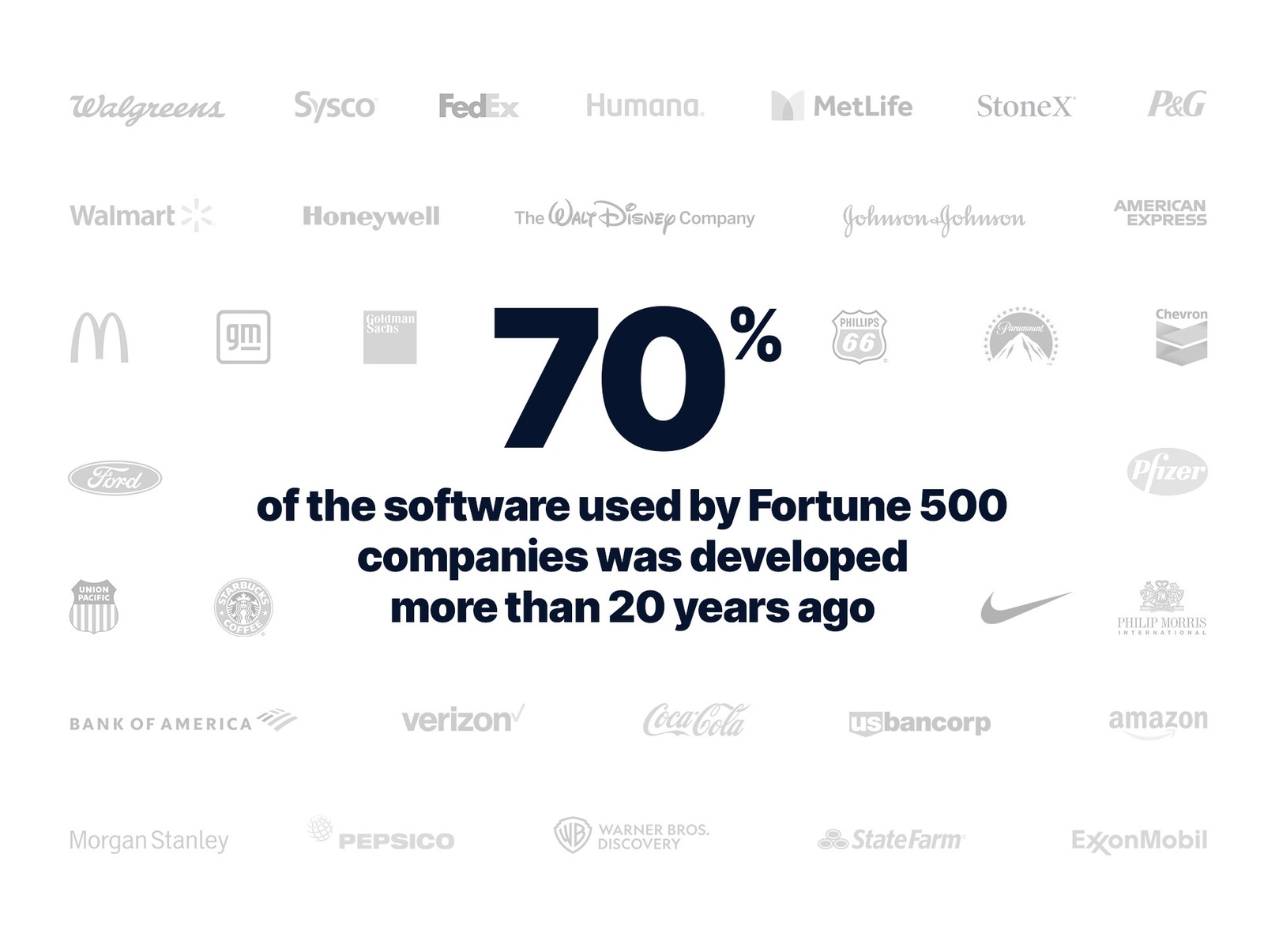
Modernizing legacy applications has become a priority for many organizations. However, that doesn’t make it easy. Across industries, companies rely on legacy systems that were built years, sometimes decades, ago. McKinsey estimates that up to 70% of the software used by Fortune 500 companies was developed more than 20 years ago.
The challenge is that while these legacy applications may still “work,” they often limit performance, scalability, security, and customer experience. Outdated technologies accumulate technical debt and increase operational costs. They also make it harder to integrate modern systems or respond to regulatory compliance requirements. At the same time, organizations fear that application modernization efforts could disrupt critical workflows or cause downtime.
At Artkai, we work on several complex legacy application modernization projects every year, helping companies in fintech, healthcare, insurance, and IoT move from outdated systems to modern solutions. And through this work, we’ve seen the same legacy application modernization challenges appear over and over again.
In this article, we’ll explain the most common challenges teams face when modernizing legacy applications and how to overcome them using a structured, low-risk modernization process.
Three Categories of Legacy Application Modernization Challenges
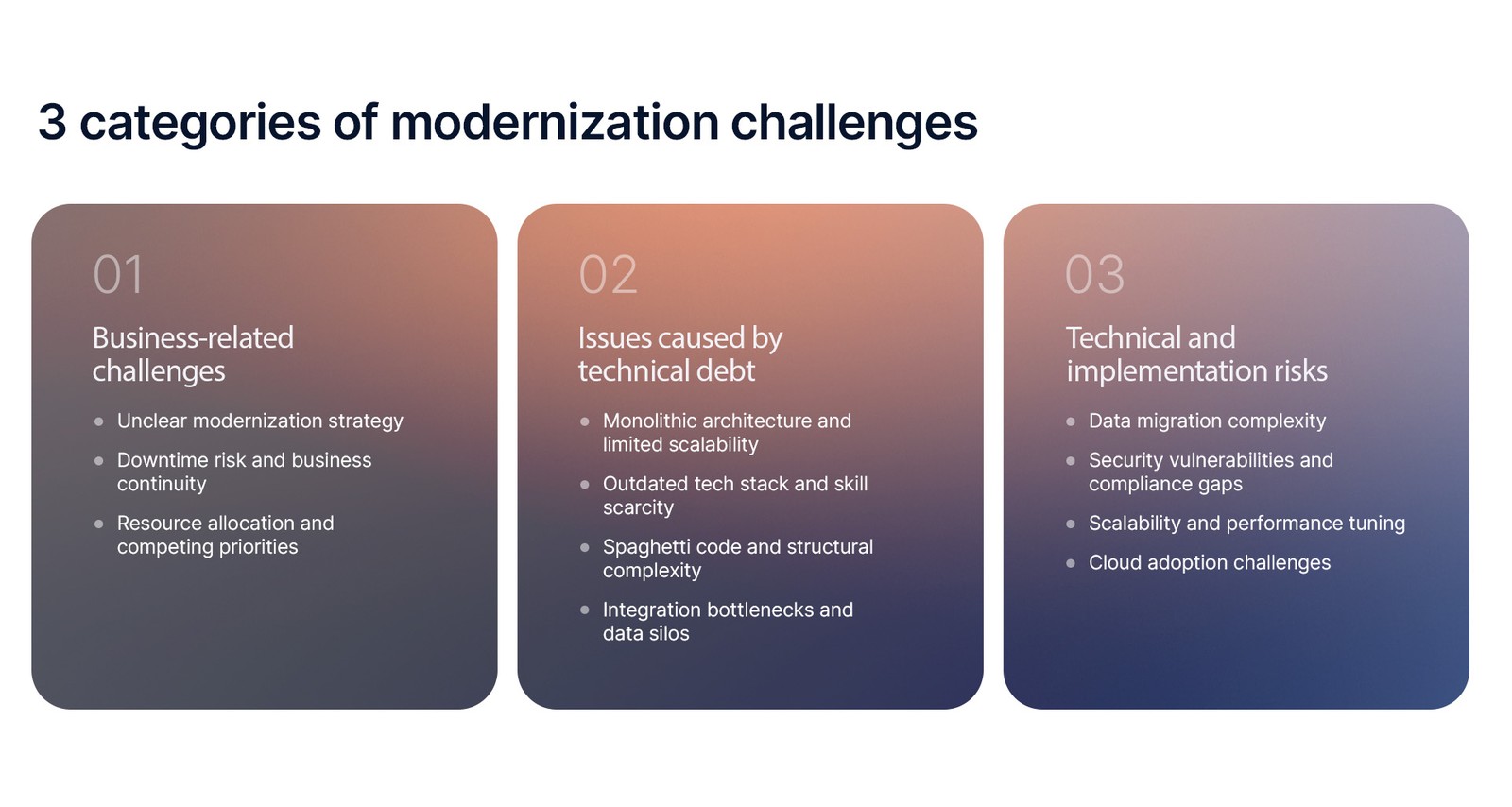
Application modernization is rarely blocked by a single issue. In practice, its common challenges tend to fall into three interconnected categories:
- Business-related challenges
- Issues caused by technical debt
- Technical and implementation risks
While legacy app modernization challenges often surface as technical problems, their root causes are usually strategic or organizational. That’s why effective application modernization initiatives demand careful planning, cross-functional collaboration, and an experienced partner to guide them on their modernization journey.
Business-Related App Modernization Challenges
Business-related challenges are often the earliest obstacles in application modernization. These issues shape decision-making long before any code is touched, and if they’re not addressed early, they can derail even technically sound modernization efforts.
Unclear Modernization Strategy
Many companies know they need to modernize, but lack a clear understanding of the modernization process: what to do, how to do it, or why now.
Deloitte’s 2024 digital transformation research shows that strategy is a primary obstacle: 58% of organizations report that the absence of a clear transformation strategy or a solid business case is one of their biggest barriers — almost twice as many as the year before.
Without a defined modernization strategy for enterprise apps, teams can default to extremes: either postponing modernization indefinitely or pushing for a complete system rewrite without understanding the risks.
How we address it at Artkai
Every legacy application modernization project we take on starts with discovery. Before proposing a modernization approach, we assess:
- Which parts of the legacy system support core business operations
- Where technical debt actively blocks performance, scalability, or security
- Which existing systems can be reused, refactored, or retired
- What business outcomes the modernization efforts must support
Let’s take a healthcare communication platform modernization project we recently delivered as an example. An early discovery phase showed that a full rewrite was neither necessary nor desirable. While some parts relied on outdated technologies and limited further development, others were stable, embedded in daily clinical workflows, and already compliant.
So, instead of replacing the system altogether, we defined a phased modernization strategy that introduced new components gradually, reduced operational risk, and ensured critical functionality remained available as the platform evolved.
Downtime Risk and Business Continuity
Many organizations delay modernization because they fear disrupting operations. This isn’t surprising, since even short outages can disrupt the system or cause financial loss.
Downtime risk is especially acute in industries like healthcare, fintech, and insurance, where systems run continuously, users depend on stable workflows, and regulatory compliance requires reliable data access.
How we reduce downtime risk
Instead of replacing legacy systems all at once, we focus on keeping everyday operations intact by:
- Running legacy and modern systems in parallel
- Maintaining backward compatibility during the transition
- Using feature flags and canary releases to control exposure
- Rolling out changes incrementally instead of through “big bang” launches
In the healthcare communication platform project we referred to earlier, years of accumulated configuration and long-established user workflows made it unrealistic to switch suddenly. Instead, we introduced new services alongside the legacy system. This allowed selected clients to adopt new functionality at their own pace, while the existing platform remained in use.
Resource Allocation and Competing Priorities
Another business-level challenge is balancing modernization work with ongoing support for existing systems. McKinsey reports that for some large organizations, up to 70% of IT capacity is spent maintaining legacy systems.
This creates a cycle where legacy applications demand constant maintenance, maintenance consumes budget and time, modernization is delayed due to “lack of resources,” and tech debt continues to grow.
How we help teams break the cycle
Effective legacy app modernization often works best when a dedicated team can work within the current system. In the healthcare communication platform project, we gradually took over support for large parts of the legacy codebase. This close collaboration and steady knowledge sharing helped move the platform forward without disrupting operations.
Vendor Dependency and Partner Selection
Some vendors jump to predefined solutions (often complete rewrites) before they fully understand how a legacy system is used or the environment it operates in. When that happens, important details like existing integrations or regulatory constraints can be discovered too late.
Our role as an enterprise app modernization company is to work within those realities from the start. We design the modernization approach around the client’s constraints and long-term needs, instead of forcing the system into a one-size-fits-all architecture.
Challenges Caused by Technical Debt
In many organizations, legacy modernization challenges are deeply rooted in years of accumulated shortcuts and workarounds that once helped teams move faster, but now slow them down.
McKinsey describes technical debt as the “tax” on technology. According to its research, technical debt accounts for roughly 40% of IT balance sheets, and companies pay an additional 10–20% cost premium on every project simply to work around existing limitations. In extreme cases, this debt forces businesses to abandon modernization initiatives entirely.
Monolithic Architecture and Limited Scalability
While monoliths are often treated as inherently bad, the reality is more nuanced. A monolithic legacy system is not automatically a blocker. The real issue is architectural rigidity. This is especially common in existing legacy systems that evolved organically over 10–20 years without a long-term architectural vision.
Problems arise when:
- The system was not designed to scale horizontally
- Core logic, data access, and UI are tightly coupled
- The system relies on single point of failure
In such cases, even small changes require full-system redeployments, making modernization efforts slow and expensive. These constraints also create serious application modernization performance challenges when user demand increases or when new integrations are needed.
How we approach it
When modernizing monolithic systems, we focus on identifying architectural pressure points that limit scalability or flexibility. This means understanding where the architecture restricts horizontal scaling, where shared state increases risk, and which parts of the system would benefit from being deployed independently.
Instead of breaking the system apart all at once, we usually start by extracting the components that change most frequently or handle the highest load. This supports gradual decomposition and allows teams to modernize without affecting existing operations.
Outdated Tech Stack and Skill Scarcity
It’s still common for organizations to rely on legacy systems, and many of these are built on outdated technologies such as older Java versions, unsupported .NET frameworks, or COBOL-based platforms. This can lead to:
- Security vulnerabilities that cannot be patched
- Incompatibility with new technologies and modern programming languages
- Shrinking pools of developers able (or willing) to maintain the system
From a business perspective, an outdated tech stack also leads to higher operational costs (because of specialized talent), lower development cycles, and increased risk as key team members leave the company.
When modernizing legacy applications, it’s usually better to take things step by step instead of changing everything at once. From our experience, we can see that replacing outdated frameworks gradually, introducing supported technologies where they fit, and letting new components grow on their own helps keep risk manageable.
Spaghetti Code and Structural Complexity
Spaghetti code is often cited as a reason to rewrite legacy systems, but not all poorly structured code is equally problematic. The real question is whether the code structure actively blocks business value.
When small changes require touching many unrelated modules, bugs are difficult to isolate, and regression risks increase with every release — that’s when spaghetti code becomes a serious modernization challenge.
Linking refactoring decisions to business outcomes helps keep modernization focused. So rather than cleaning code “for cleanliness’ sake,” we focus on components that introduce stability or security concerns and modules that block integration or scaling.
Integration Bottlenecks and Data Silos
Integration bottlenecks may look like performance problems, but they usually stem from architectural constraints. Many legacy systems were built before seamless integration was a requirement. As a result, they often rely on shared databases instead of APIs, custom point-to-point integrations, and manual data synchronization processes.
We recommend addressing integration bottlenecks by rethinking how legacy systems interact with the rest of the architecture. A common modernization approach is to add API layers around the systems and separate data access from business logic. This makes it easier to connect newer systems and modern technologies (like cloud-based services or AI-based tools) without destabilizing the legacy core.
Technical and Implementation Challenges in Application Modernization
Even with a clear modernization strategy and a realistic view of technical debt, many application modernization initiatives stumble once the work begins. This is where plans that look good on paper meet the operational reality of existing systems, real users, live data, and the need to keep business operations running.
In our experience, the most difficult challenges show up during execution, not design. They surface when teams try to modernize legacy applications while preserving the workflows the business relies on every day.
Data Migration Complexity
Data migration concerns are among the top reasons organizations delay their modernization journey. This hesitation is justified because, while code can be rewritten or refactored, data carries business logic, regulatory obligations, and operational dependencies that can’t be easily replaced.
Yet, legacy systems often store data in formats that are poorly documented, tightly coupled to application logic, and/or shared across multiple legacy applications. All this makes straightforward “lift-and-shift” approaches too risky.
In complex legacy app modernization projects, we:
- Preserve existing data structures as long as they remain stable
- Introduce parallel storage or synchronization layers
- Migrate data incrementally, aligned with component-level modernization
In the healthcare communication platform project, we chose not to make major data changes at the start. Core data models stayed backward compatible, while we added new services alongside the existing system. This kept the platform running smoothly and allowed the architecture to change over time.
Security Vulnerabilities and Compliance Gaps
Legacy systems are still widely used in highly regulated industries, and they can introduce real security risks. HIMSS data shows that outdated technology was the initial access point in 24% of major healthcare security breaches. In many cases, this comes down to unsupported libraries and frameworks, weak authentication, inconsistent access controls, or gaps in audit logging.
At the same time, many organizations hesitate to modernize because compliance is always part of the picture, whether that’s HIPAA, GDPR, PCI DSS, or industry-specific regulations. However, when security and compliance are part of the modernization process, not a final checklist item, the process stays under control.
We recommend starting with:
- Auditing security vulnerabilities in legacy systems
- Deciding which issues must be fixed immediately and which can be addressed in modern components
- Aligning modernization efforts with existing compliance frameworks
During modernization, we assess the regulatory and security requirements the system already needs to meet, and where gaps may have appeared over time. In regulated environments like healthcare, we work within the client’s existing compliance processes, keeping security and compliance consistent. This reduces friction and ensures modernization aligns with real operational constraints.
Scalability and Performance Tuning
Scalability and performance issues are common in legacy applications that were designed for steady, predictable workloads and not for step-by-step improvements. Indeed, tightly coupled architectures, often built around shared databases and synchronous processing, make it hard to scale only the parts of the system that need it.
These application modernization performance challenges usually surface when organizations move to the cloud, introduce real-time processing, start adding new features, or want to integrate emerging technologies.
One way to tackle these issues is to focus on structural changes that reduce coupling and allow for more controlled scaling by:
- Identifying components under the highest load or most frequent change
- Decoupling performance-critical functionality
- Introducing asynchronous processing where real-time responses are unnecessary
- Applying changes incrementally to avoid disrupting business operations
Cloud Adoption Challenges
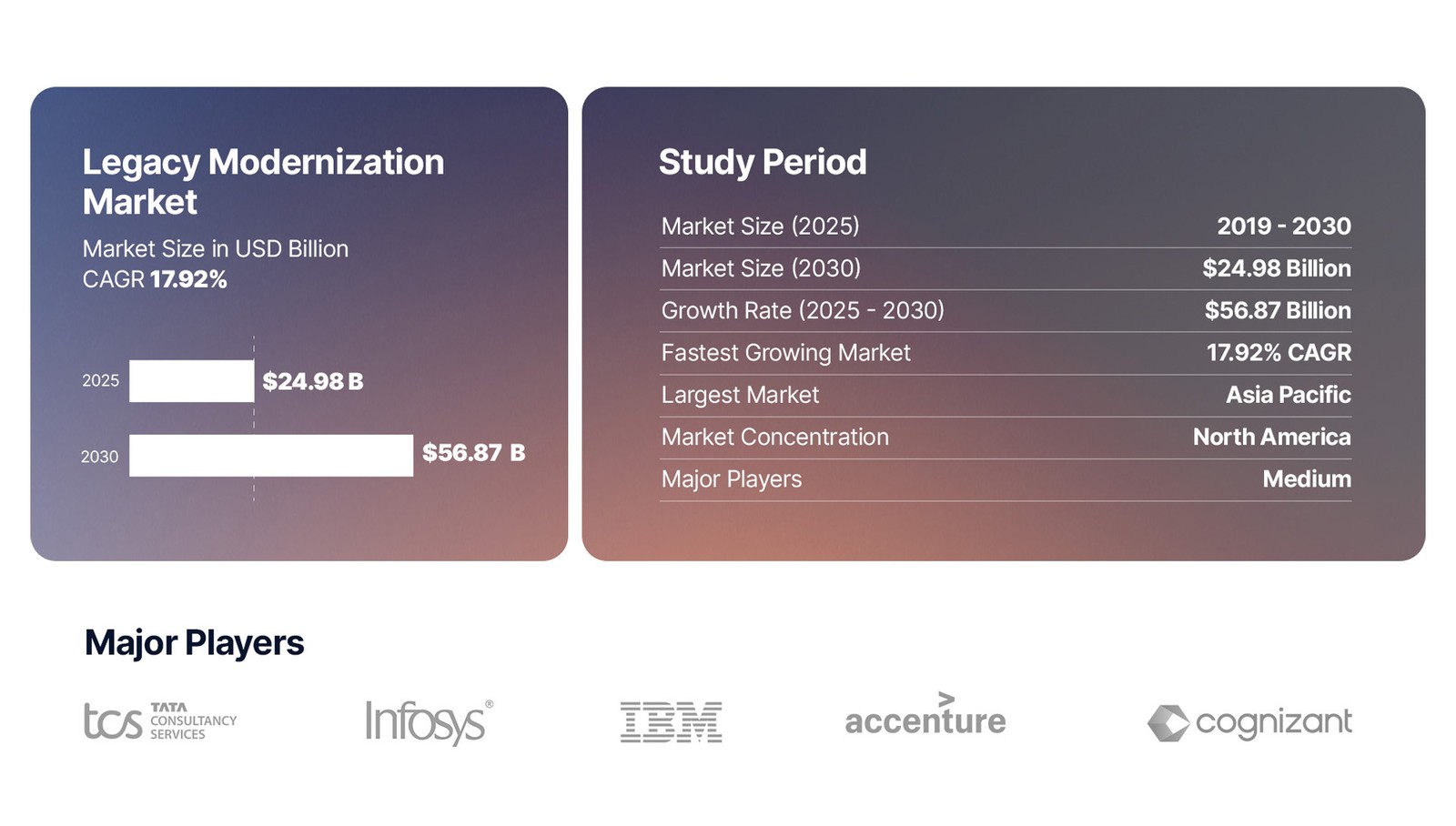
Research from Mordor Intelligence shows that the cloud is a common destination for legacy modernization, with most initiatives involving cloud environments in some form.
At the same time, full cloud migration is rarely realistic for complex, long-running systems. So hybrid architectures remain common, particularly where legacy platforms are deeply embedded in daily operations or constrained by regulatory requirements. And sometimes simply rehosting an application in the cloud can improve infrastructure flexibility without addressing underlying architectural bottlenecks.
In the healthcare communication platform we modernized, parts of the system were initially designed for local, self-hosted deployments and maintained customer by customer. Therefore, the team adopted an incremental cloud approach, moving selected components toward cloud or cloud-native services while keeping others self-hosted, which resulted in a hybrid architecture.
Best Practices We Use to Mitigate Modernization Risks
At Artkai, we’ve worked on dozens of complex application modernization projects, including systems in healthcare, fintech, insurance, and IoT. Over time, we’ve found that certain practices help keep common challenges manageable and reduce disruption, even when systems are large and business-critical.
Start With a Clear Modernization Strategy
Before any technical work begins, we align on what problem the modernization effort is meant to solve right now and which results matter in the near term.
To do this, we work with the client to define the primary objective the system needs to support, clarify which limitations cannot be compromised, and structure the modernization process around concrete milestones the team can work toward and measure. This creates a shared reference point for architectural choices and delivery sequencing, so decisions are guided by agreed outcomes instead of ad-hoc judgment calls.
Choose the Right Modernization Approach for Your Context
“Rehost vs. replatform vs. rebuild” sounds straightforward on paper, but real legacy systems are rarely that neat. Instead of applying a single approach across the entire system, we look at each major part separately and choose what makes sense in context.
This decision is shaped by how much technical debt has built up, how often the component needs to change, how tightly it’s connected to other legacy parts, and how critical it is to the business.
In practice, this usually leads to a mixed setup. Some components are rehosted to stabilize things and buy time, others are refactored to remove specific blockers, and only the parts that can’t reasonably move forward in their current form are re-architected.
Prioritize Incremental Modernization
Large, all-at-once rewrites usually assume a level of system knowledge that most legacy environments no longer have. Incremental legacy application modernization works better because it keeps assumptions small and visible.
We structure the work so that:
- Changes are introduced gradually
- Legacy and modern components can run side by side
- Each step has a clear rollback path
This makes it possible to observe how the system behaves in real conditions and adjust along the way.
Strengthen Data Migration and Security Planning Early
Data migration is where many modernization projects quietly fail. Inconsistent schemas, hidden dependencies, and unclear ownership tend to surface late and slow down delivery or force unplanned rework.
We begin by mapping which data sources are authoritative, how information moves between existing systems, and which security or compliance requirements must remain intact during the transition. This gives the team a clear picture of what can change safely and what can’t. Only then do we define migration paths, synchronization logic, and the necessary security controls.
Build a Cross-Functional Modernization Team
Modernization touches product logic, infrastructure, UI/UX, data, and operations. And if these areas are handled in isolation, important dependencies tend to show up late, when they’re harder to deal with.
We build teams that bring architects, engineers, designers, QAs, and DevOps into the project from the start to validate assumptions faster and limit unnecessary changes later. Additionally, clear ownership (usually through a modernization lead or PM) keeps decisions aligned as priorities shift.
Invest in DevOps and automation early
Ironically, systems get more complicated early in a modernization project. New services are introduced, existing legacy components are adjusted, and old and new versions often run side by side. That means more deployments to manage and more dependencies to watch.
DevOps practices help teams stay in control from this early stage. By setting up automated delivery early, changes can be released more often without risking stability.
Choose a Reliable Modernization Partner
Application modernization involves working with systems that carry years of technical debt, undocumented behavior, and fragile integrations, while keeping the software running. On top of that, you have to make decisions about architecture and sequencing early, because reversing them later is often costly and disruptive.
Less experienced teams often focus on adding new technologies or changing what’s most visible, while deeper structural issues stay in place. Choosing a partner with hands-on experience in large, business-critical modernization projects helps avoid that trap.
Teams with real legacy application modernization experience know how to identify risks that aren’t obvious at first glance and move different parts of the system forward in a way that doesn’t interrupt daily operations.
Conclusion
Application modernization usually involves the same common challenges: unclear priorities, accumulated technical debt, risky data changes, and limits around performance or security. These issues are well known and tend to appear in most legacy systems.
At Artkai, we approach modernization through careful discovery, incremental change, and close collaboration with client teams. This makes it possible to update existing systems while gradually removing the barriers that slow development or increase risk.
If you’re planning a modernization effort and want experienced guidance, Artkai can support you. We help teams assess their options, manage risk, and move legacy systems forward in a controlled way. Contact us today.
Clients and Results






Schedule your free consultation
Don't miss this opportunity to explore the best path for your product. We are ready to delve into the specifics of your project, providing you with expert insights and optimal solutions.
Book your free sessionRead More
Explore articles from Artkai - we have lots of stories to tell
Join us to do the best work of your life
Together we advance the human experience through design.