AI MVP Development
Generative AI development company features that change most for your users
Generative AI belongs where it changes what a user gets. Our custom generative AI development services rank those places in your product, prototype the strongest one in your own screens and build it, with a plan for what happens when the model is wrong.
The situation
A chatbot nobody asked for
The board asked what the product does with AI, and the quickest answer was a chat window in the corner. Users open it once. The place where a model would have saved them an hour a week, the report they rebuild by hand every Monday, is still untouched.
Generative AI features in a product you already run
The AI Opportunity Audit goes through your product and the data it holds, and ranks the places where a model would change what a user gets, with the reasoning and what happens when the model is wrong. The strongest idea comes back as a clickable prototype drawn in your own screens.
LLM development with a plan for the wrong answer
A language model will sometimes be wrong, so in our LLM development services each feature is designed with what the user sees when it is unsure: a draft to approve, a source to check, a person to ask. That plan is part of the scope, not an afterthought.
Where generative AI helps users and where it needs a check
Generative AI earns a place where users rebuild something by hand again and again, such as a report, a reply or a summary, and a draft from a model saves the work. Where a wrong answer is costly, the same feature is designed around a source to check or a person to ask.
The audit ranks the features on both counts: what each one changes for the user, and what it costs when the model is wrong. The ranking, not a chat window in the corner, decides what gets built.
Generative AI in products we have built
For a US tech company's sales platform we built an AI helpdesk that suggests replies to support tickets and can shorten, lengthen or summarize a response, and an AI knowledge base that recognizes a question and generates the answer. The first version was launched and tested by users, whose feedback fed the next improvements.
The MVP of an AI interior design app, on web and mobile, includes AI suggestions based on a user's preferences and a library of AI-generated designs. At a US health-tech company, designers used AI-augmented design to generate the missing components, Storybook documentation and front-end code, with senior designers in control of UX quality throughout.
AI Opportunity Audit before any model is built
The first step for a product you already run is the AI Opportunity Audit: up to two weeks, including a spike. From your side we need a product lead and an outline of what data exists.
At the end you hold a prioritized list of AI features with the reasoning, and a clickable prototype of the first one (one to three days inside the audit). For generative AI, each feature on the list comes with what the user sees when the model is wrong.
Case studies

AI-powered sales platform
A sales platform that keeps customer data in one place: CRM, a helpdesk with suggested replies, a workflow builder and a knowledge base.Case study →

AI-powered interior design app
An AI-powered web and mobile app that helps people redesign a room, choose furniture and find where to buy it.Case study →
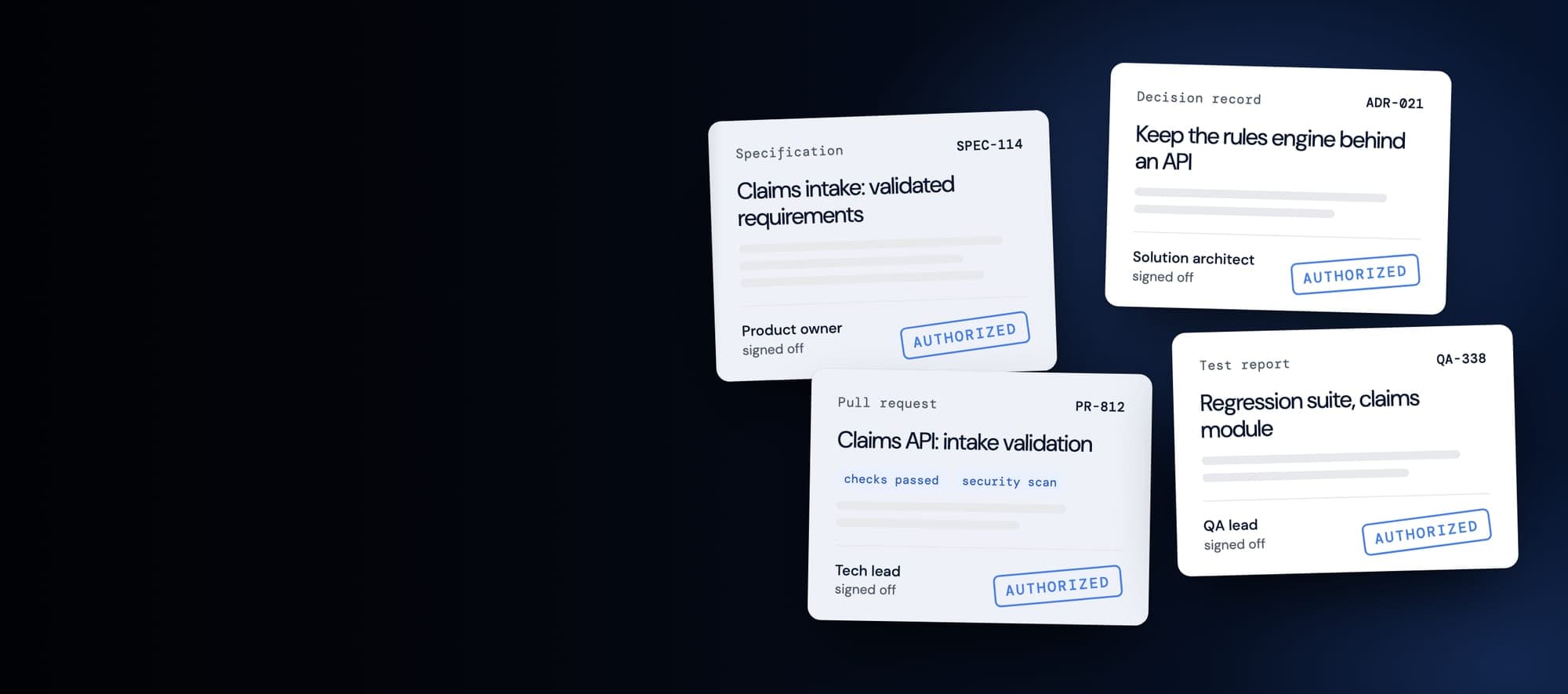
Artkai AI SDLC at a US health-tech company
Agents documented legacy systems and turned validated requirements into test cases.Case study →
Questions
What do your generative AI development services include?
An audit of where generative AI fits your product, a clickable prototype of the strongest idea, and the build on the Artkai AI SDLC, where each stage ends in a document one accountable person authorizes. That is what our generative AI software development services mean in practice.
Do you build LLM features into existing products?
Yes. Most of the work is LLM app development for a product that already has users and data, with a model added at the point where it changes what they get.
What happens when the model is wrong?
That is designed before the feature is built. The user gets a draft to approve, a source to check or a person to ask, depending on what a wrong answer would cost.
Where does a generative AI project start?
For a product you already run, with the AI Opportunity Audit: up to two weeks, including a spike, ending in a prioritized list of AI features and a clickable prototype of the first one. For a new product, it starts with Scope and prototype, about two weeks.
What generative AI features have you built?
An AI helpdesk that suggests replies to support tickets and an AI knowledge base that generates answers, for a US tech company's sales platform. An AI interior design app with a library of AI-generated designs. AI-generated design components and front-end code at a US health-tech company.
Is generative AI the same as an AI agent?
No. A generative AI feature changes what a user gets inside a product, such as a draft reply or a summary. An agent takes one step of a business process and hands every exception to a person on your side.
Related
AI MVP Development
A new product scoped, prototyped and taken to its first release on the Artkai AI SDLC, then maintained under the same method.
AI Integration
When the AI is not generative, or goes deep into a platform you already run.
AI Agents
When the model should take a step of a business process rather than a feature of a product.
Product Design
When the feature needs its screens designed and handed over as working code.
Start with a call
A 30-minute call with someone who has delivered this kind of work — sales and an engineer together.