Service
AI-assisted software development answer the board with your own team's numbers
AI-assisted software development, sometimes called AI-powered software development, means agents do defined work at each stage of delivery, from requirements and tests to code and review, while an engineer on your side authorizes what moves on. We install it in your own engineering team rather than sell it as seats: we measure what your current AI tools deliver and fit the Artkai AI SDLC around your stack, so the method stays after we leave. You can begin with that measurement, or with working tests on one module in about a week.
The situation
The AI numbers in the board pack are seats bought and seats active
Every engineer has a Copilot or Cursor seat. The only numbers anyone can pull are seats bought and seats active, and those are the ones that went into the board pack. Some teams swear by the tools and others quietly stopped using them in the spring. Reviews feel slower and pull requests feel bigger, but nobody took a baseline before the rollout, so there is nothing to compare today with.
The next board meeting will ask what AI in software development has changed in your team, and whether to buy more. The honest answer today is that nobody knows, and a vendor's slide is not an answer the board will accept twice.
For the engineering leadership, the gap is not another tool. It is a baseline taken from your own repositories, and a process in which agents do defined work at defined stages and a person on your side authorizes what moves on.
How we work
Two ways to start one process in your CI at the end
AI strategy consulting that starts from your own data
Before anything changes, we measure lead time, review time and change failure rate for each team, taken from your repositories and CI, and interview the teams that use the tools and the ones that stopped. You get a report that says what the current tooling is worth, what limits it and which process change would raise it, in a form the board can read. It is the part of an AI strategy that rests on your own numbers rather than on vendor claims.
Tests running on one module in about a week
The quickest way to see the method work in your repository. We take a handful of user stories for one module, and agents turn them into test cases and test automation that run in your CI when the pilot ends. One engineer of yours stays within reach, and a short report says what is covered and what the tests found. Whichever start you choose, the next track builds on what it showed.
AI-augmented software development, fitted to your stack
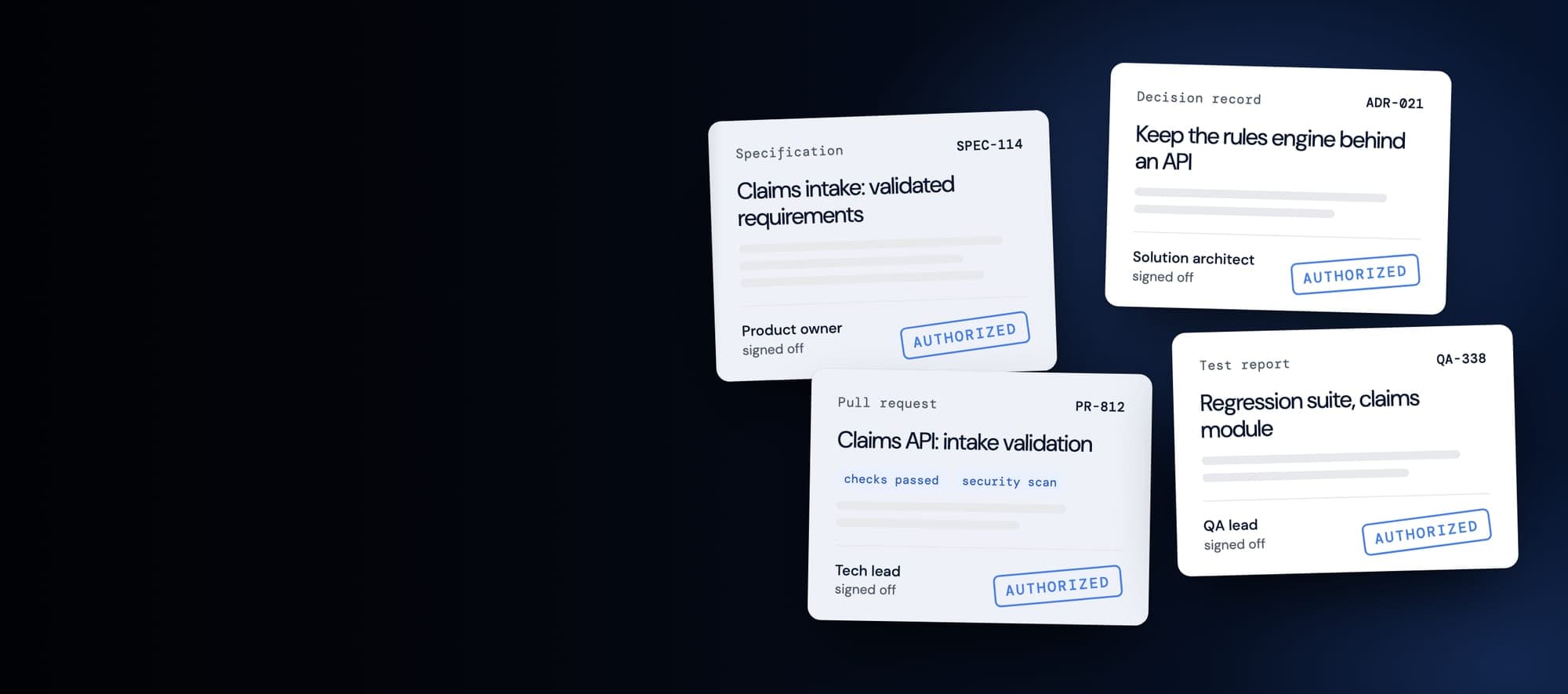
The Artkai AI SDLC, adapted to your repositories, your review rules and your definition of done: which stages agents work in, which document each stage ends in, who authorizes it, and what a gate in your CI checks before a change moves on. You decide where your gates sit. This is AI-augmented software development as a process your engineers run, not a tool rollout.
AI transformation of engineering, one team first
One team runs the new process while we measure the same things as in the first track, so the board sees a before and an after from your own engineers. The process then extends team by team, with the gates wired into your CI and the documents kept in your project, so they keep working when we are gone.
Measured effect report
- Question
- What has the current AI tooling changed in how long a change takes from first commit to release?
- Baseline
- Lead time, review time and change failure rate for each team, taken from your repositories and CI before anything is changed.
- What the interviews add
- Where engineers say the tools help, where they stopped using them, and what they do instead.
- Finding
- An example of the kind of finding: code is generated faster than review can absorb it, so review time is where the gain disappears.
- For the board
- One page: what the tooling is worth today, what limits it, and the process change that would raise it.
What you get
From a measured baseline to gates in your own CI
The measurement says what the tools are worth today, the pilot shows the method on your code, and the installed process is what your teams keep.
A baseline the board can read
What your AI tooling has changed so far, measured rather than estimated.
- Lead time, review time and change failure rate for each team
- Interviews with the teams that use the tools and the ones that stopped
- Where the gain disappears, and why
- One page for the board: what the tooling is worth, what limits it, what would raise it
Tests on one module
The method at work in your repository before you commit to more.
- Test cases drawn from a handful of your user stories
- Test automation written with agents, running in your CI
- A short report: what is covered and what the tests found
The process, installed
The Artkai AI SDLC adapted to how your teams already work, and left with them.
- The stages agents work in, and the document each one ends in
- Who on your side authorizes each document
- Gates wired into your CI, placed where you decide
- A pilot team measured before and after
- The process extended team by team
Proof
The Artkai AI SDLC at work in a health-tech company
“Artkai has always been extremely flexible to work with the needs of the project.”
First step
Copilot Reality Check
How long
up to 2 weeks, two people from our side
From you
engineering leads and teams for interviews; read access to repositories and CI
You hold at the end
the measured effect of the current AI tooling — lead time, review time, change failure rate — plus interviews, in a report that can go to the board
QA pilot on one module
How long
about a week, 3–5 user stories
From you
repository and CI access, one engineer reachable
You hold at the end
working tests running in your CI, and a short report: what is covered and what the tests found
Questions
What is AI-assisted software development, compared with handing out AI coding tools?
Handing out tools gives each engineer an assistant and leaves the process as it was. AI-assisted software development changes the process: agents do defined work inside defined stages, from requirements to test automation, and a person authorizes what leaves each stage.
What does AI-assisted software development look like in a team?
Each change passes through the same stages: requirements, tests, code and review. Agents draft the work inside each stage and the document it ends in; an engineer reads that document and authorizes it, and a gate in your CI checks it before the change moves on. Your engineers keep the decisions and the repository.
Is this AI consulting or hands-on work?
Hands-on, and AI-assisted development inside your own team. The process ends adapted to your stack and wired into your repositories and CI, so it keeps working when we are gone. The consulting part is the measurement and the decision on where your gates sit.
How is this different from other AI consulting services?
Most AI consulting ends in a strategy and a set of slides. Here the strategy rests on a baseline taken from your own repositories, and what we leave behind is a working process: stages agents work in, documents a person authorizes, and gates in your CI.
How do you measure what our AI tools deliver today?
We measure lead time, review time and change failure rate, and interview the teams that use the tools and the ones that stopped. The report says what the current tooling is worth and what limits it, in a form the board can read.
What is the quickest way to see it work?
A QA pilot on one module: agents turn a handful of user stories into test cases and test automation that run in your CI in about a week.
What does an AI transformation of engineering look like in practice?
One team runs the new process, a form of AI-driven software development, while we measure the same things as before, so the board sees a before and an after from your own engineers. The process then extends team by team.
Do you offer generative AI consulting for engineering teams?
Yes, aimed at how software gets built. At a health-tech company, agents documented legacy systems and turned validated requirements into test cases.
What has the Artkai AI SDLC done in a team like ours?
At a US health-tech company, agents reviewed applications built by different teams, reconstructed their product logic and gathered requirements, which were validated and then turned into test cases. Their VP of Software Engineering reviewed us on Clutch.
Who stays in control of the code and the decisions?
Your engineers. You decide where the gates sit and who authorizes each document, and the record of who authorized what stays in your project.
How to use AI in software development so the gain shows up in delivery?
Change the process, not only the tools. Let agents do defined work inside each stage, have a person authorize what leaves it, and measure lead time, review time and change failure rate before and after.
What is the AI impact on software development in your own team?
You find out by measuring it. We take lead time, review time and change failure rate from your repositories and CI, and interview the teams that use the tools, so the answer comes from your own data.