Home / Artkai AI SDLC
Our method
Artkai AI SDLC an agentic SDLC with one accountable person at every gate
What is AI SDLC? Ours is an agentic SDLC, an AI-native way of building software in which agents do the work inside each stage and one accountable person authorizes what leaves it. It is new. It sits on years of building regulated systems before agents existed, and this page says what we can show for it so far.
Six stages six artifacts
Agentic software engineering here means that agents do the work inside each stage. Every stage ends in an artifact and a security check, nothing leaves it until one accountable person has authorized it, and the client's own project records who and when, including after the system is live.
What the Artkai AI SDLC produces
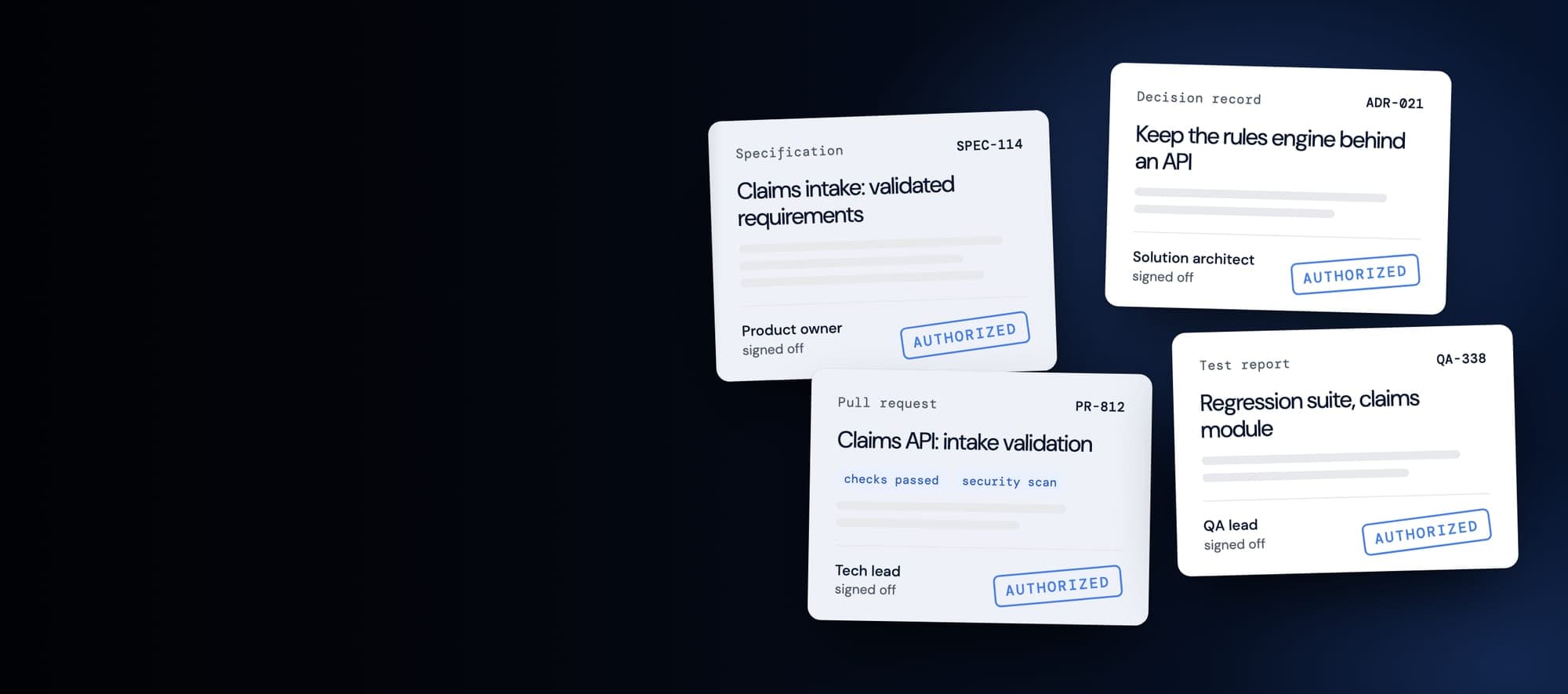
Every stage ends in an artifact and a security check, and every artifact is authorized by one accountable person. The record sits in your project, which is where your auditor looks. The documents below are illustrations of the format.
- 09:12ACoding agent opened PR-812 against SPEC-114AI
- 09:31ATest agent added 48 tests, all passedAI
- 09:33ASecurity agent scanned the change, no findingsAI
- 10:05EEngineer reviewed the diff and signed off stage 03Signed
- 10:06PPipeline started stage 04, test report QA-338Rules
- 11:40QQA lead asked for one more edge casePerson
The next stage starts only from an authorized artifact. The roles on the documents show who holds each gate; the record in your project keeps the person and the date.
What it gives you
Ready for your audit
When someone asks who approved what and when, the answer is already there.
No late surprises
Problems surface at the stage that owns them, not the week before release.
Security keeps pace
Security is settled as the work happens, so nothing comes back after it is built.
Faster, not looser
Features reach customers sooner, and with AI-driven development every control above stays in place.
What a gate is
One accountable person
Every artifact is authorized by a single person who answers for what passes. Your project record keeps who and when.
A written decision
What was approved, what was rejected and why.
A stage that waits
The next stage starts only from an artifact that has passed its gate. Until it does, the work stays where it is.
Set against what you are weighing
| The alternative | How it usually works | With Artkai AI SDLC |
|---|---|---|
| Your own team with Copilot or Cursor | Each engineer gets quicker at writing code. The process around the code stays the one you had. | The stages, artifacts and gates are set up around your tools, in your repositories. That is what Enablement installs. |
| Another outsourced team | You direct the work and check it yourself, usually by reading hours and status reports. | You review authorized artifacts at each stage instead of hours, and your project keeps who authorized each one. |
| A consultancy | A strategy and a plan for your team to carry out. | Engineers who build with the method and leave the Artkai AI SDLC running in your repositories. |
Where it has run
A client case we can describe
At a health-tech company, we applied agentic AI in the SDLC: agents documented legacy systems and turned validated requirements into test cases. The longer record behind the method is the work we did before agents, on the Work page.
There is no speed or cost multiplier for the method on this site. One returns when a documented engagement can carry it.
Put the method inside your own team
We measure what your current AI tools deliver, adapt the AI SDLC framework to your stack, prove it on one team and wire the gates into your own repositories and CI.