The full case study
Lendora, step by step
On this page · 11 sections
About the business
We cooperated with a well-established US consumer lending company that has been operating in the offline loan market for over a decade. The company recognized the shift in customers’ expectations and needs and made a strategic decision to launch an MVP of their first fintech solution. It should be a digital consumer lending platform offering a solid set of features and user-centric design.
The company approached us with the request to help them design, develop, and launch a modern lending product called Lendora from scratch. The primary objective was to bring a fully functional MVP to market quickly, allowing the company to:
- test the concept with real users
- onboard users and gather their feedback
- start scaling keeping in mind the feedback
Lendora should become the foundation for their new digital direction, with plans for long-term growth and continuous improvement. So our team started this project and over the course of 8 months we helped our client to move into online lending with newly launched MVP of Lendora.
Project tasks and challenges
As an established offline lender transitioning into digital space for the first time, our client faced several strategic and technological challenges. So when they came to us their request was to start with an MVP first and then with time turn it into a future-proof lending platform.
Key tasks and challenges of our team involved in this project included the following:
- Delivering a functional MVP fast. One of the top priorities was to design, build, and release a fully working MVP in a short timeframe. The MVP should support core loan operations, provide a smooth borrower experience, and be robust enough to onboard real users.
- Performing digital transformation from the ground up. With no existing digital ecosystem, we needed to build everything from scratch — borrower interfaces, internal dashboards, backend systems, and infrastructure.
- Creating a borrower-first experience. Our mission was to design a digital flow that would be clear and trustworthy for users familiar with traditional, in-person lending.
- Integrating legacy processes with new tech. We should put offline lending workflows into digital logic, automating loan servicing processes.
- Ensuring security and compliance. All digital operations had to be compliant with KYC, AML, and data security regulations. So our team should embed compliance controls into the architecture from day one.
We understood that while the MVP development and launch had to be fast, at the same time, Lendora had to be designed with scalability in mind. Plus it should be aligned with business goals and milestones of the client. So keeping it all in minds we started working on Lendora.
Project team
- Project Manager
- Business Analyst
- 2 UX/UI Designers
- 3 Front-end Developers
- 2 Back-end Developers
- QA Engineer
- Solution Architect
5 months for Discovery & Design
7 months for development & testing
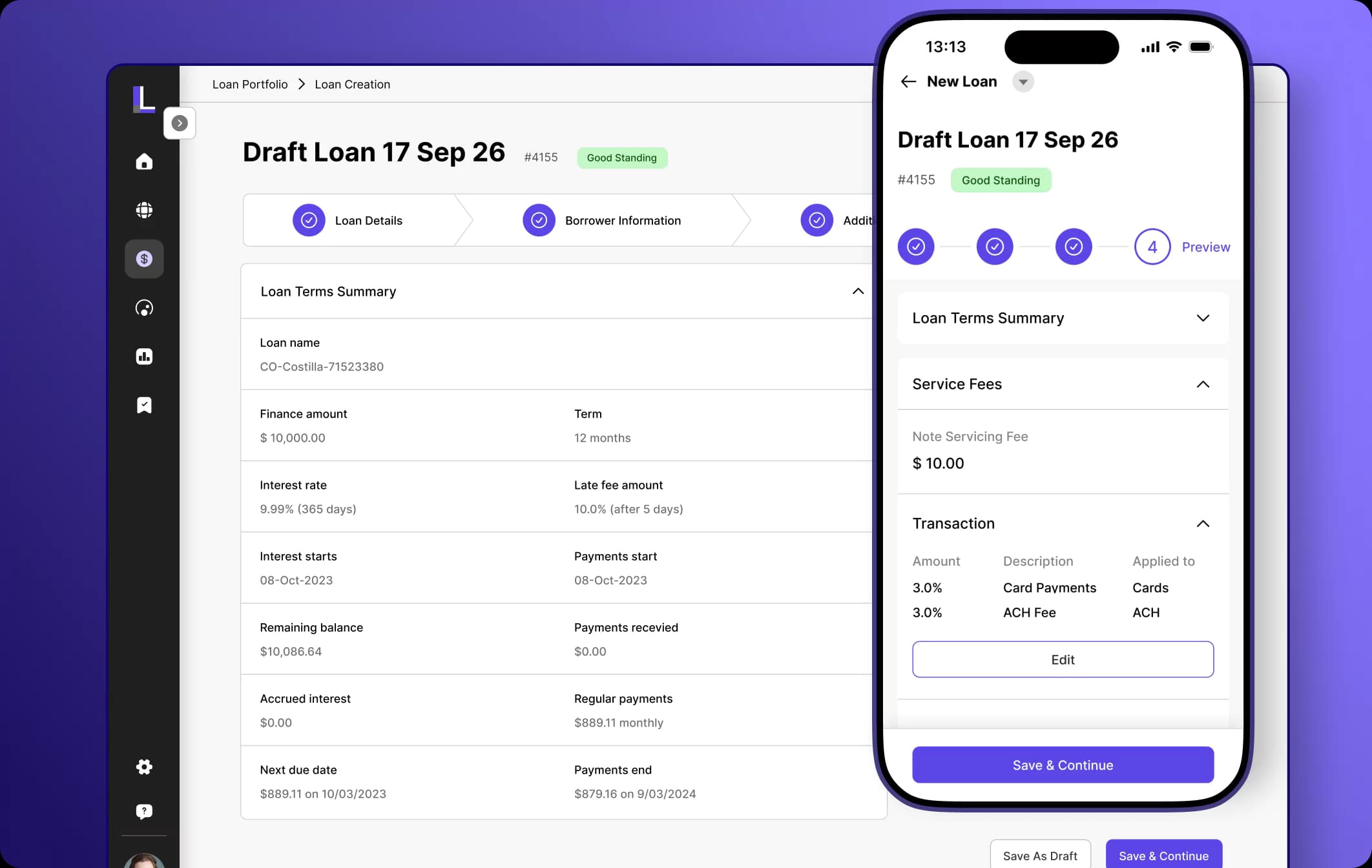
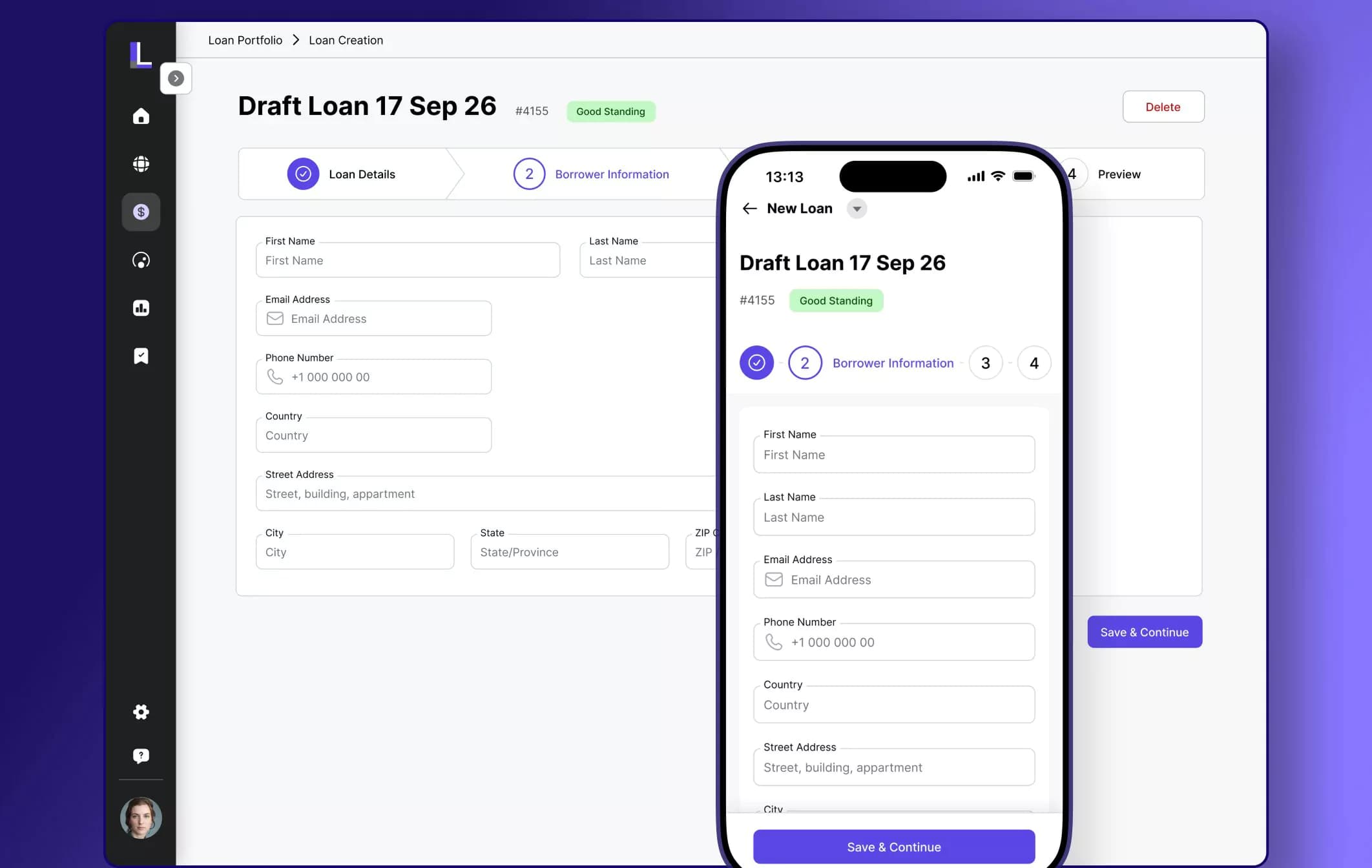
Loan Application & Onboarding
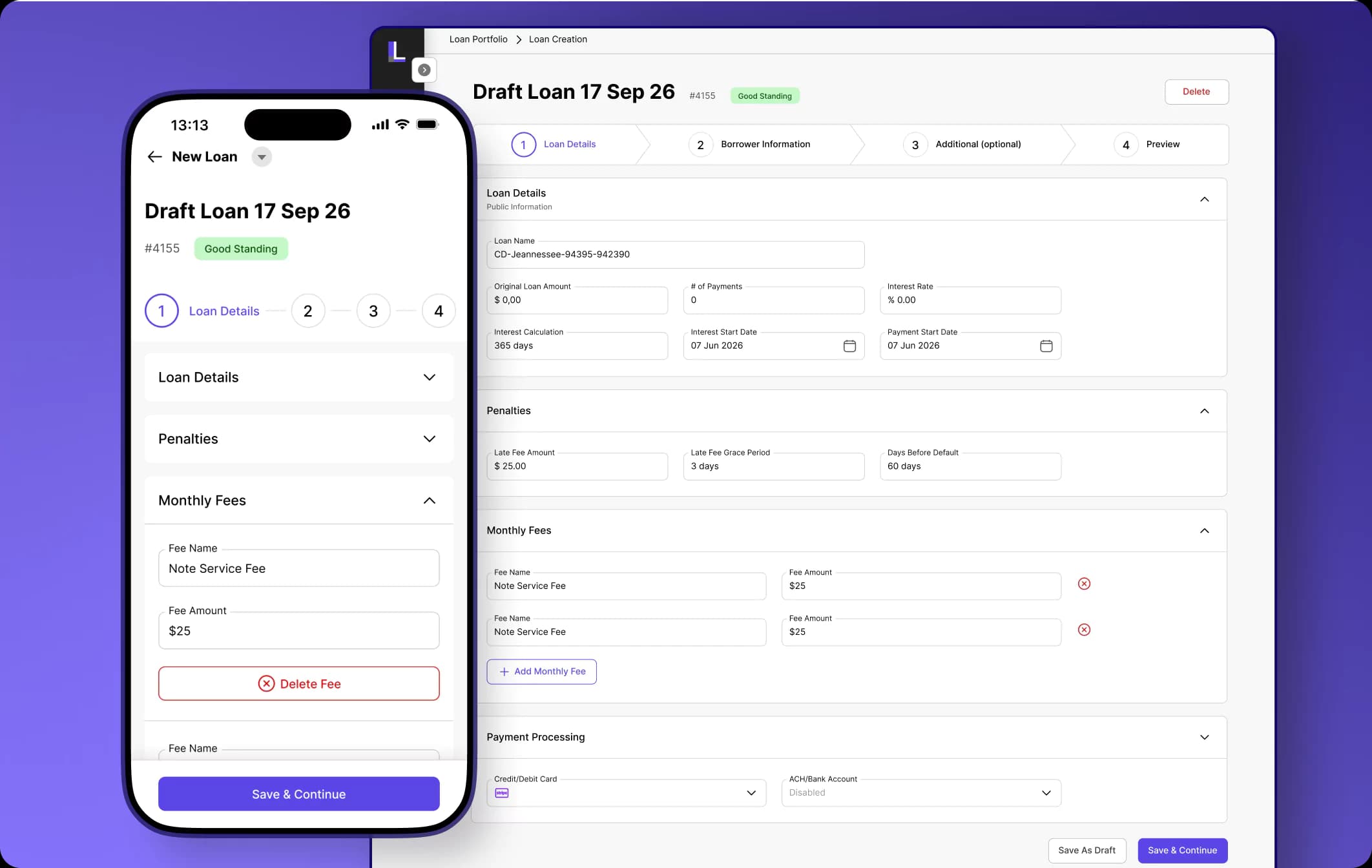
Our goal was to streamlines the borrowing process by guiding users through a clear and intuitive flow – from initial inquiry to loan approval. To achieve this goal we decided to design an intuitive onboarding and application flow. Here is what we added:
- Intuitive application form – Borrowers fill in all necessary information step-by-step and this reduces confusion and drop-offs.
- Seamless onboarding flow – We added clear instructions, progress indicators, and document upload option to ensure a smooth start for all new platform users.
- Loan details – Users can view and update all details, check application statuses, and manage future loan applications in one place.
Loan Management & Servicing
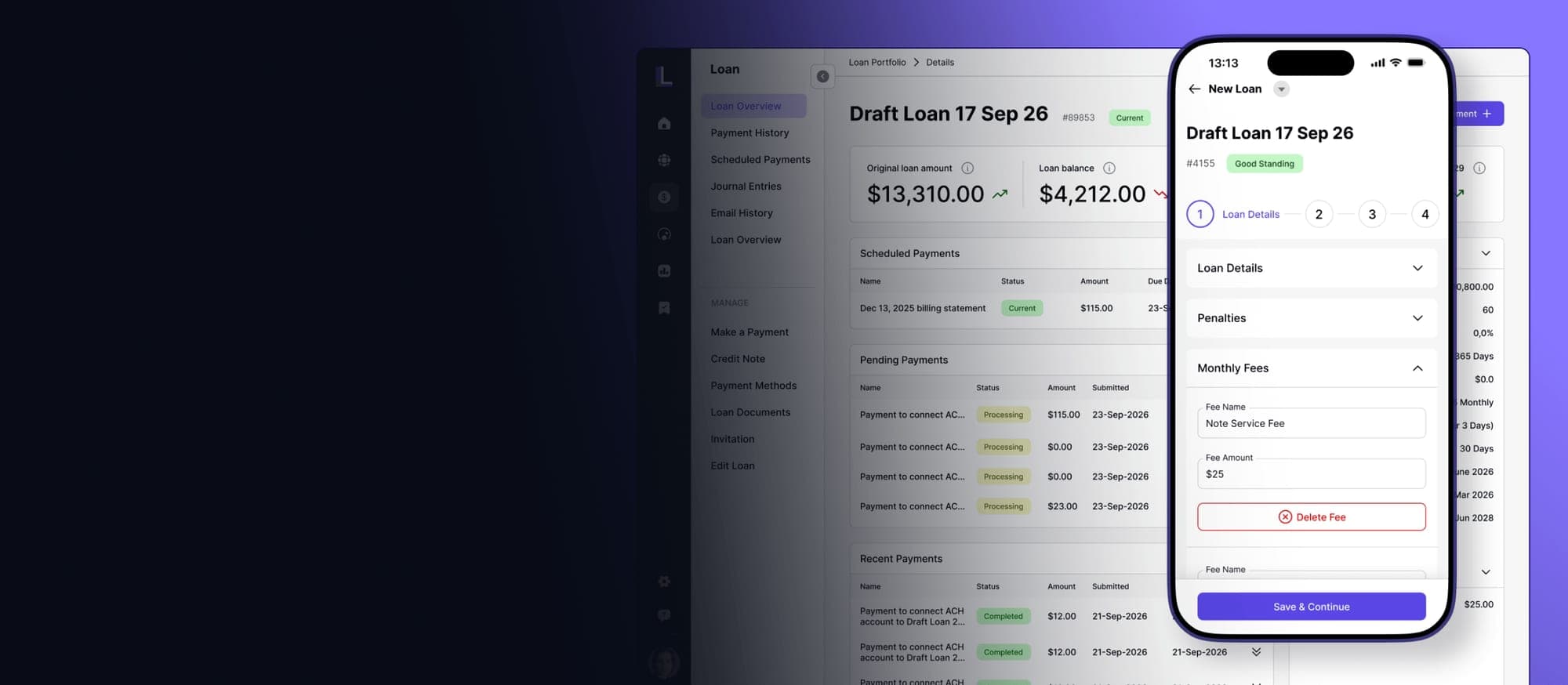
This feature is designed to help lenders efficiently oversee the entire loan lifecycle starting with origination and ending with repayment and closure. To ensure end-to-end loan lifecycle management we added a variety of tools like:
- Loan modifications – It helps to make changes in repayment terms, interest rates, or schedules based on borrower eligibility.
- Real-time tracking – Allowing to monitor outstanding balances, due dates, and repayment history and send borrowers automated notifications.
- Pre-payments and settlements – That helps to set early repayments with automatic recalculations and final settlements.
- Reversals and adjustments – That simplifies process of payment reversals or corrections with full audit trails.
Automated Underwriting
Our client wanted to accelerate loan approval processes and speed up decision-making with automated underwriting. By leveraging predefined rules and external borrower data, Lendora helps to reduce manual work, minimize errors, and maintains compliance with lending regulations.
We added fast approval process that automates credit risk assessment and allows lenders to provide faster loan decision. Lendora allows to use preset rules and algorithms for consistent decision-making. All underwriting processes adhere to regulatory requirements and borrowers can get real-time loan approval or rejection notifications.
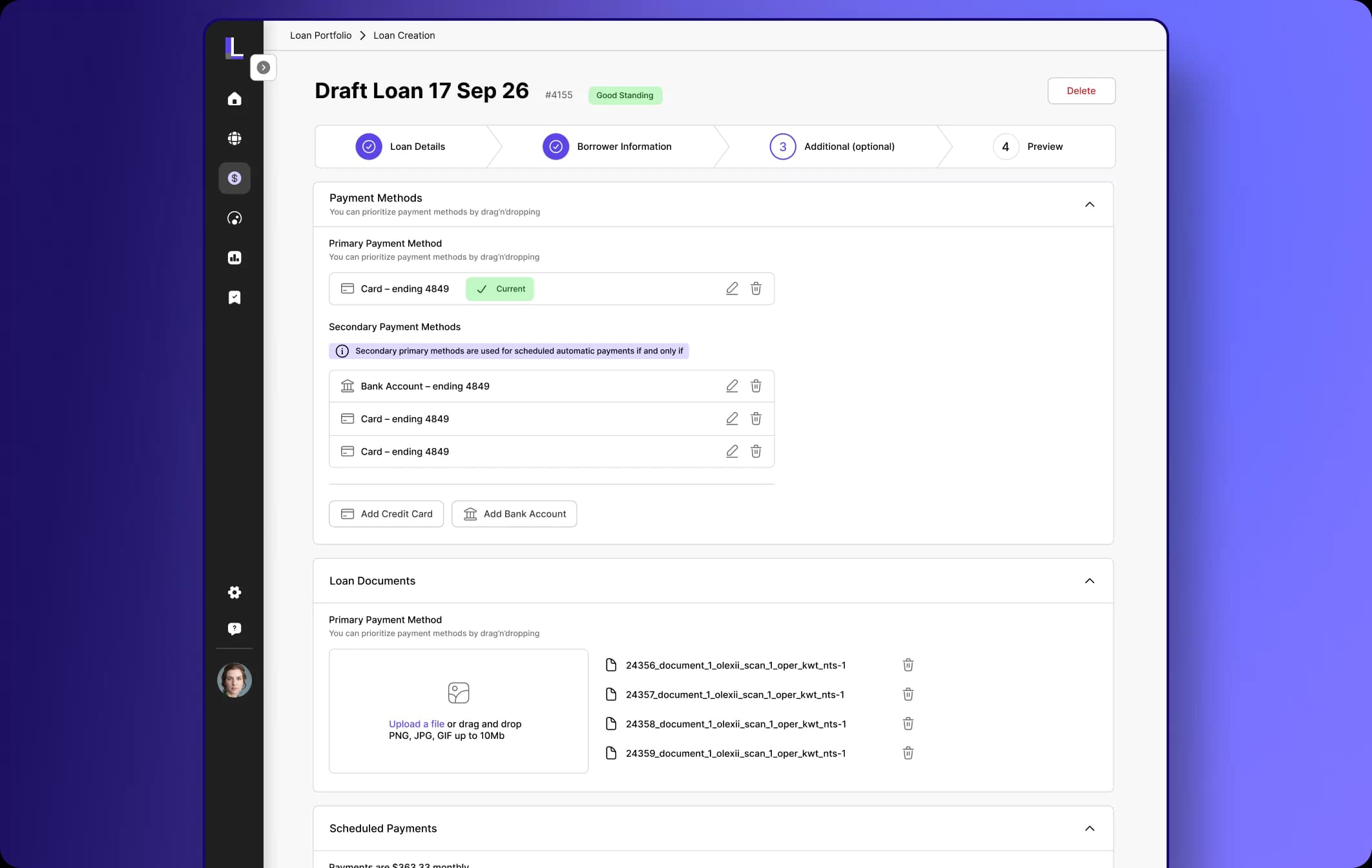
Payment Processing
We added a smooth and secure way to manage borrower payments while reducing manual errors. There is a flexible payment processing tools that support ACH/NACHA transactions, handle failed or partial payments, and ensure late fees are applied accurately.
Lendora allows borrowers to make payments easier and more automated while giving lenders total control over payments allocation and cash flow. We implemented automated reminders and retry mechanisms to reduce delinquencies. Our software engineers also took care about security, so all transactions are encrypted and compliant with financial standards.
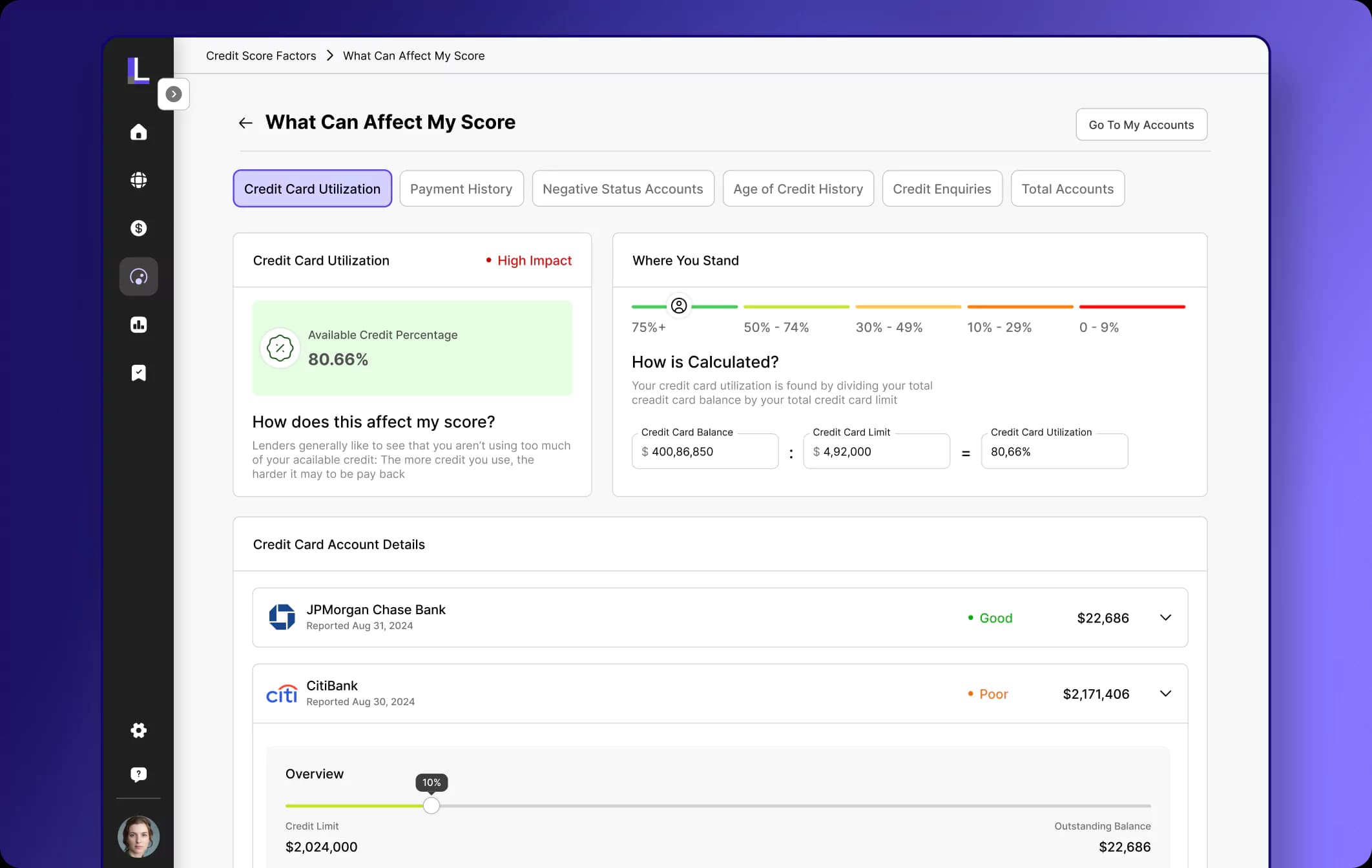
Credit Scoring & Risk Assessment
This advanced feature helps evaluate borrower creditworthiness by integrating with credit bureaus and 3rd parties data sources. Here is what else we added to make credit scoring and risk assessment maximally automated:
- Real-time credit scoring. Lendora can automatically fetch and calculate credit scores based on the latest borrower information.
- Risk assessment. It utilizes advanced algorithms to assess borrower risks and predict repayment likelihood.
- Data-driven insights. Lenders can make more informed lending decisions with detailed credit reports and financial history parsed from other sources.
More Platform Features
Flexible Loan Products
This feature enables lenders to design and manage a wide range of customizable loan offerings tailored to diverse borrowers needs – different terms, interest rates, payment structures, and fees.
Amortization & Tracking
Lendora allows to automatically generate payment schedules, track payments, and manage loan account transactions ensuring full transparency into loan balances.
Borrower Communication & Self-Service
The platform can send automated statements, reminders, and closure documents. The borrowers can also access a self-service portal to view their payment history, upload documents, and track their loan status.
API Integrations
Lendora is connected with crucial third-party systems for credit checks, employment verification, and KYC helping to enrich borrower profiles and streamline lending processes.
Development approach
To begin with, we focused on creating an intuitive and transparent journey for borrowers, from onboarding to repayment. We applied accessible, inclusive design practices to create a frictionless experience that will make financial decisions feel safe and easy. Our design team:
- Mapped key user flows and pain points.
- Crafted a clean, responsive UI system for web and mobile.
- Developed a shared component library for consistent UX.
We also took care about cross-platform UI consistency by using React for web and React Native for mobile. This tech stack helped us to ensure visual and functional consistency across platforms. We also resorted to shared styling with reusable components to speed up Lendora development and testing.
Speaking about backend, our goal was to make it ready to scale. So our software engineers built a modular backend using Node.js, TypeScript, and PostgreSQL. Now the architecture of Lendora supports:
- Custom loan product configurations.
- Automated loan schedules and payment recalculations.
- Prepayment handling and loan modifications.
To extend the platform’s capabilities, we ensured seamless integration with third-party services like:
- Credit bureaus & KYC providers for scoring and verification
- Payment systems (Stripe, ACH/NACHA) for secure, automated processing
- Twilio & SendGrid for transactional communication
- Firebase for mobile push notifications
Lendora turned out secure and compliant platform. All data exchanges are encrypted, and created backend complies with financial regulations (KYC and AML). We implemented authentication with Amazon Cognito, role-based access, and audit logging to ensure full traceability and protection.
The platform was containerized with Docker and deployed on AWS ECS. We used CI/CD pipelines for smooth deployments, and Amazon CloudWatch for real-time error tracking and performance monitoring.
Outcome
In just 8 months, we helped our client to move from a digital lending concept to market-ready MVP. We’ve successfully launched Lendora that received positive user feedback and soon will be scaled into a fully-fledged product.
The MVP turned out robust and included all core lending features allowing our client to enter the market with a strong, functional product. Here is what else we’ve accomplished:
- Created a scalable and future-proof architecture. Lendora was built using a React, React Native, Node.js, PostgreSQL enabling easy and seamless scaling, integration of new features, and expansion of the platform’s capabilities over time without reworking the foundation.
- Enhanced borrower experience. With a seamless digital interface, borrowers can now apply for loans, manage payments, upload documents, and receive notifications – all from their phone or browser. The intuitive UI drastically increased user satisfaction.
- Ensured compliance and data security. Lendora is fully compliant with U.S. lending regulations ( like KYC and AML). We’ve also implemented secure user authentication, role-based access control, audit trails, and encrypted data processing.
Working closely with the client’s legal, compliance, and operations teams, we successfully managed to translate traditional workflows into digital processes. Lendora became a solid foundation for client’s digital presence.