The full case study
FleetFlow, step by step
On this page · 10 sections
About the Business
We were contacted by a company headquartered in Austin, Texas. UrbanLink Logistics specializes in creating logistics solutions for 3PL/4PL operators, different e-commerce brands, and marketplaces. They wanted to create a brand new white-label customizable solution able to streamline delivery operations and improve customer experience.
So the initial request of UrbanLink was to help them build that new platform called FleetFlow. It should offer first-class design, rich functionality and be built with scalability and flexibility in mind. FleetFlow should allow B2B clients of UrbanLink to perform:
- management of fleets, routes, and SLAs from a console
- real-time tracking of delivery
- easy task management and proof-of-delivery through mobile interface
- dynamic route optimization using AI-powered features
It was an ambitious project that we finished in just 12 months and helped UrbanLink to expand their portfolio and clients’ list.
Project Tasks and Challenges
Our main goal was to build a white-label, AI-powered solution with an architecture supporting enterprise-level scalability and seamless integrations of additional services. On top of that, FleetFlow should offer three key user flows and an intuitive UX.
This ambitious goal required a structured step-by-step approach. Here is how we did everything:
Step 1. Discovery phase
We started with conducting a thorough discovery and thinking through what functionality FleetFlow should have. During the discovery, we created a product vision, delivered a roadmap, and decided how AI would be used to make FleetFlow a smart solution.
Step 2. Building functionality for 3 types of users
FleetFlow is supposed to be used by 3 types of users: dispatchers, drivers, and customers. So we needed to integrate must-have features for each of them and create:
- Console for operations management.
- Driver App for navigation and proof-of-delivery.
- Customer Tracking.
Step 3. Integrating AI-powered features
We integrated AI to automate operations such as route optimization, predictive ETAs, task assignment, and SLA risk detection.
Step 4. Working on integrations
Our client wanted FleetFlow to be able to easily connect with widely used e-commerce platforms (i.e., Shopify, WooCommerce, Magento), ERP, WMS, and TMS systems of their B2B clients, location services, and payment providers.
Step 5. Creating scalable architecture
We designed a scalable architecture enabling tens of thousands of daily deliveries with at least several thousand peak orders/hour. And we also ensured a high level of security via GDPR/CCPA compliance and PII masking.
As to the technical challenges we faced during FleetFlow development, we can highlight the following:
- Creation of a cloud-native, microservices architecture able to handle large data volumes and offering configurations that can support dozens of independent clients with unique branding, workflows, and SLAs.
- Creation of configurable workflows and integration of an AI module to enable smart delivery prioritization and routing based on region, delivery type, and capacity.
- Development of dedicated AI microservices powered by OR-Tools, XGBoost, and streaming pipelines via Kafka.
- Integration with diverse e-commerce, ERP, and WMS/TMS systems that required REST APIs, GraphQL endpoints, and webhook-based automation.
Project team
- Project Manager
- Business Analyst
- 2 UX/UI Designers
- 3 Front-end Web Developers
- 2 Mobile Developers
- 4 Back-end Developers
- 3 QA/AQA Engineers
- Solution Architect
- DevOps Engineer
6 months for Discovery & Design
11 months for Development & Testing
Task Management
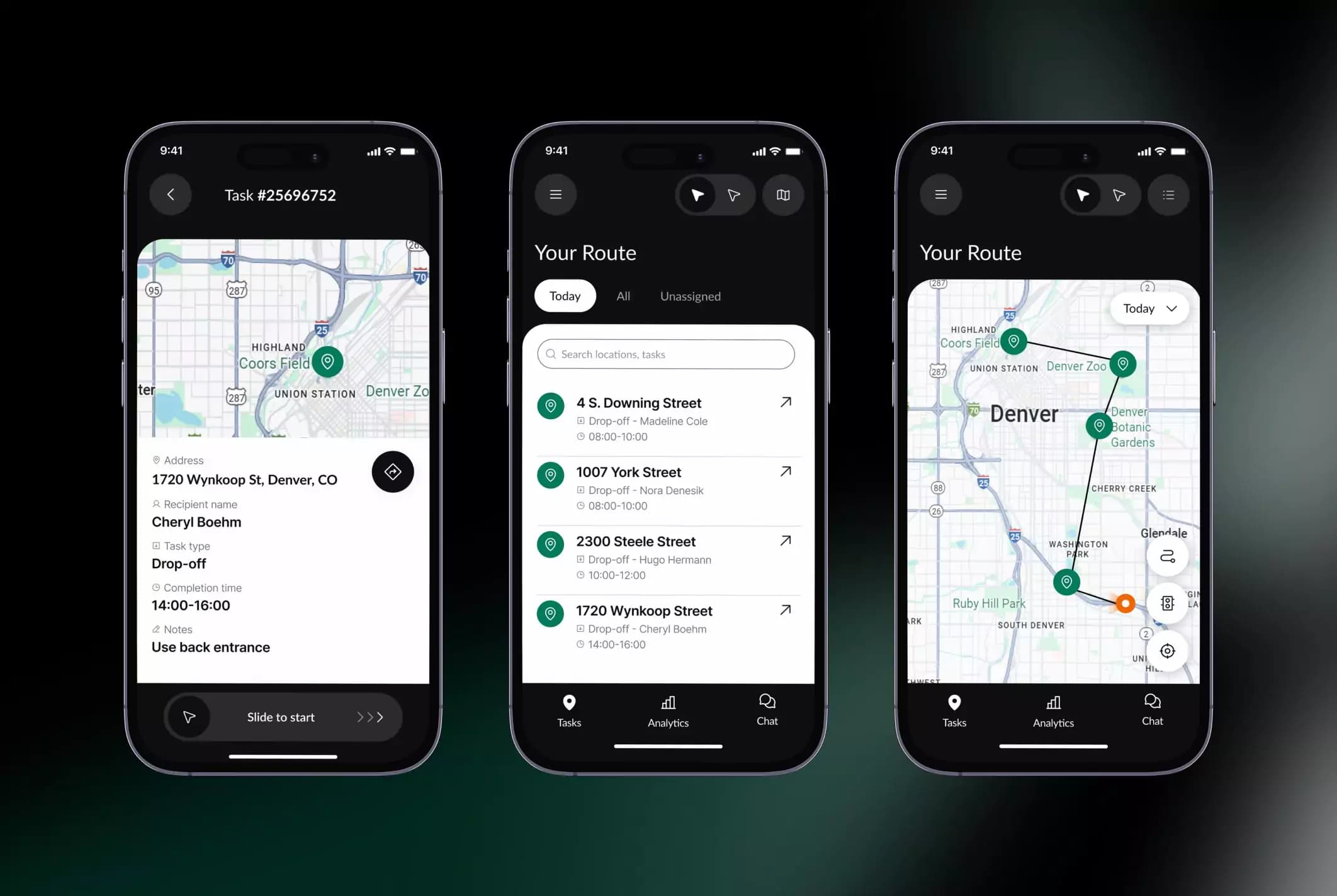
While building the Driver App, we took special care of the task management feature. Our goal was to enable drivers to easily view, manage, and complete their everyday delivery tasks without being distracted by mundane operations. To make this possible, we added the following functionality:
- Task overview helping to see a complete list of tasks or switch to a map view for an overview of the optimized route.
- Task details that contain all must-have info, such as delivery address, recipient information, type of task, and time frame.
- “Hold to Start” functionality that starts a task and tracks its progress automatically.
- Real-time sync helping to send all updates to the Operations Console and requiring no manual check-in.
Other Features
Real-Time GPS Tracking
Due to this feature, all deliveries can be tracked in real time as the Driver App can instantly share live location data. If something unexpected occurs, dispatchers can proactively manage deliveries. Accurate GPS data also empowers more precise ETA predictions.
AI-Powered Route Optimization
We integrated AI to enable FleetFlow to discover the most efficient delivery routes based on key inputs such as distance and traffic details. If any of the critical conditions change, the routes are automatically updated to ensure timely delivery.
Proof-of-Delivery
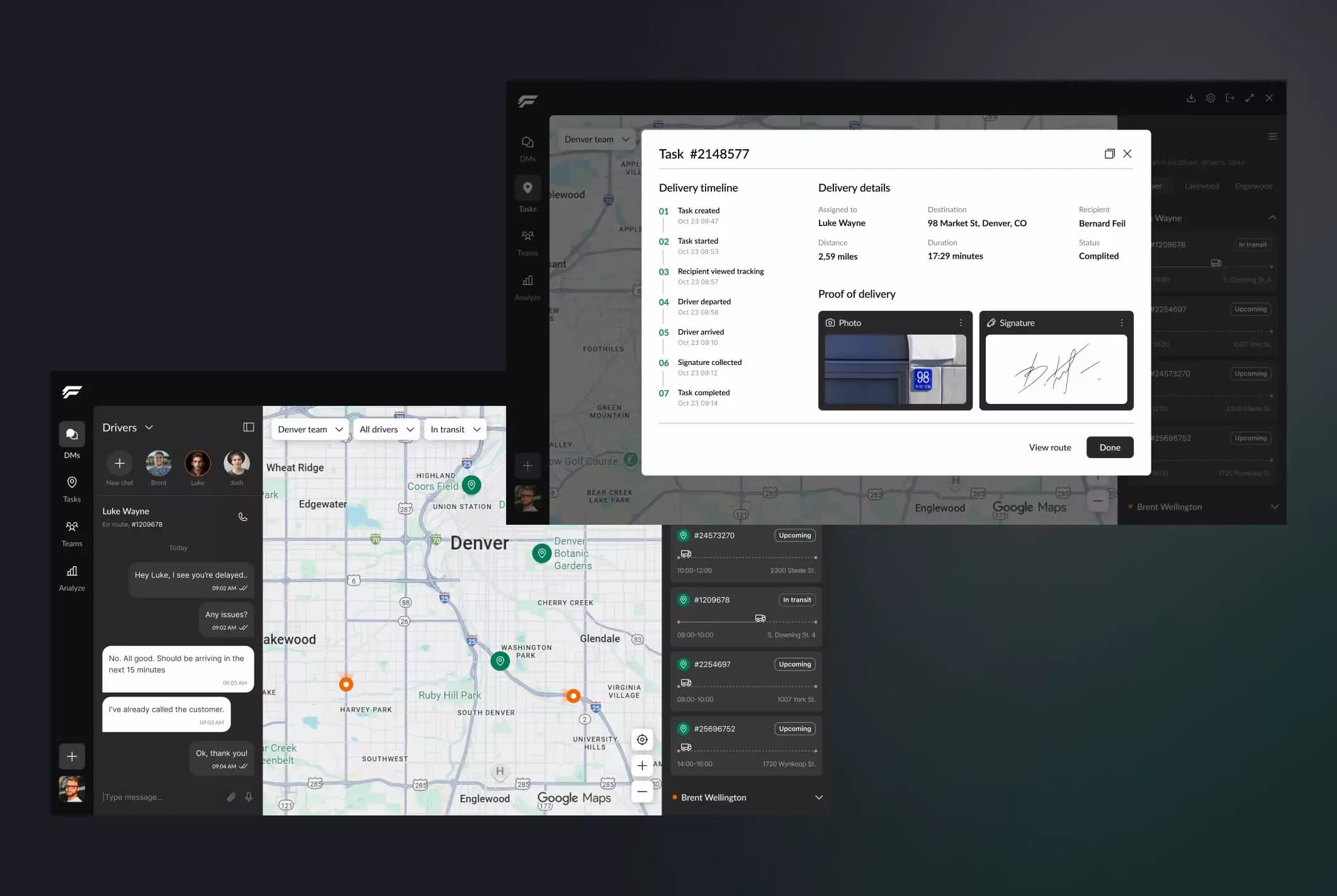
This feature was designed to help instantly confirm successful deliveries using digital signatures, photos of delivered packages, barcode and QR code scans. This way, both the businesses and their customers benefit from the transparency of delivery.
Customer Notifications
FleetFlow has an automated notification system that is connected with the Driver App. So drivers performing deliveries always know when customers receive ETA updates as their tasks progress.
Built-in Messenger
To establish efficient communication, we integrated messaging and call options, helping to start a chat with the dispatchers, discuss all issues, and contact customers without sharing personal numbers.
Push Notifications
Drivers receive instant updates about their delivery tasks, changes to set routes, and urgent SLA-sensitive orders. These push notifications help drivers to stay informed about all changes in real time.
Integrated Navigation
We integrated FleetFlow with Google Maps and Mapbox to let drivers get directions directly from the task view. So they don’t need to switch between different apps for managing workflow and navigating the route.
Platform AI Capabilities
Dynamic Route Optimization
We implemented algorithms to calculate the most efficient delivery routes. They take into account traffic, weather, and delivery priorities and update routes according to changes of these factors.
Predictive Delivery ETA
The platform can predict delivery time and adjusts it dynamically. It uses live location and historical data and sends dispatchers and customers updates about potential delays in the real time.
Task Auto-Assignment
FleetFlow automatically distributes tasks between drivers based on their proximity and workload, helping to reduce manual work usually performed by dispatchers.
Proactive Risk Detection
All active deliveries are automatically monitored to detect potential issues, such as traffic jams or too overloaded routes. The app highlights risks early on before they affect SLAs.
Operations Console
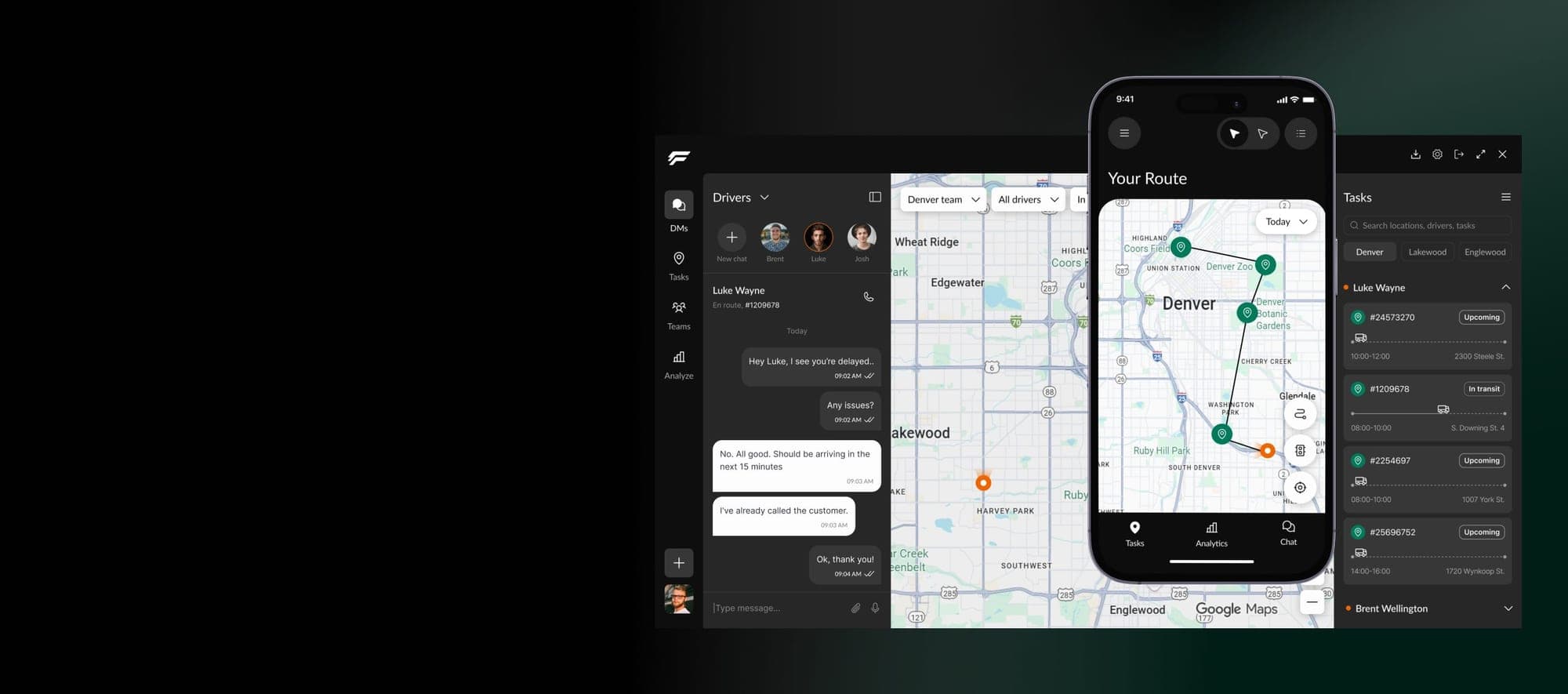
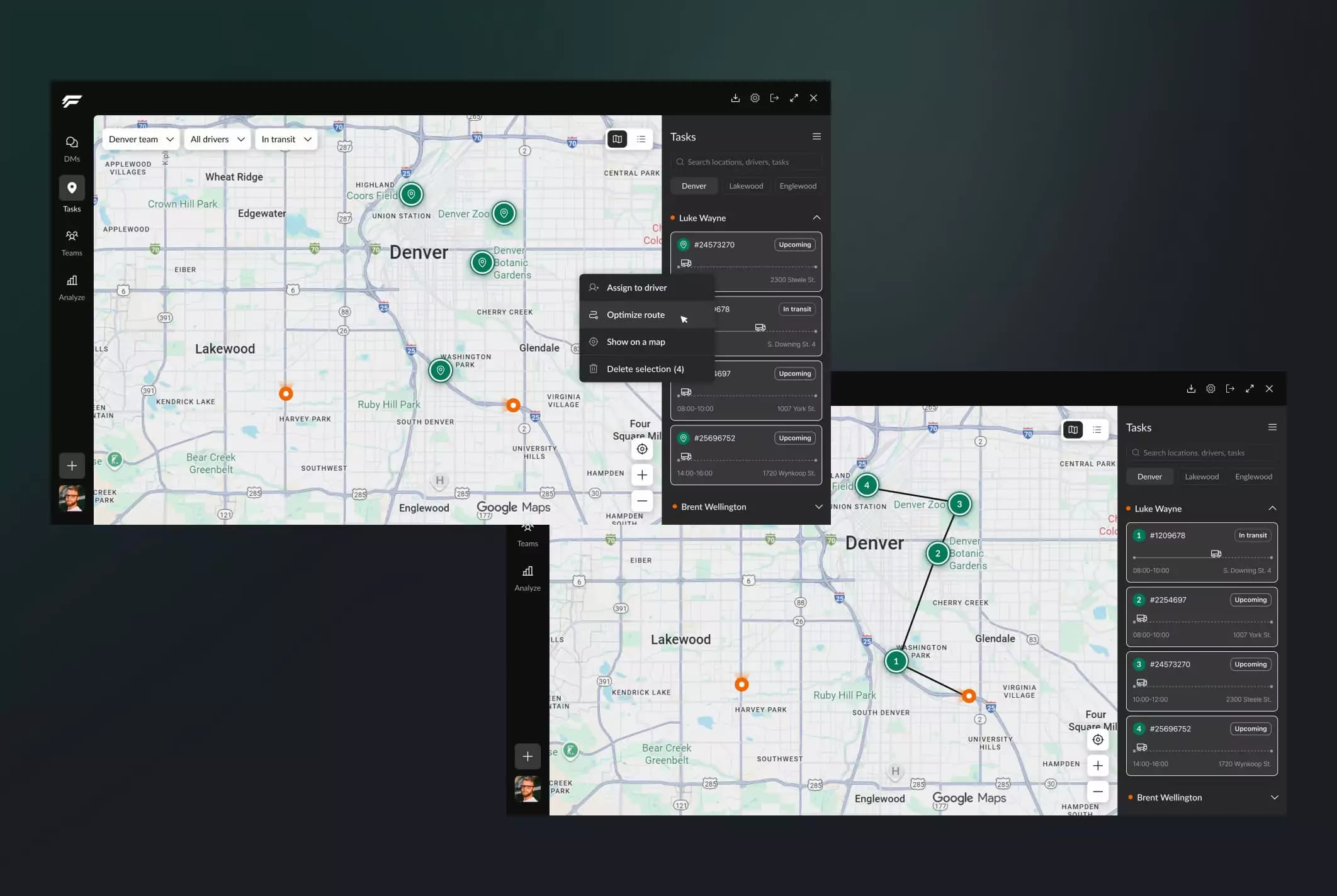
Operations Console acts as a central hub for dispatchers, managers, and administrators and helps to manage delivery workflows, fleets, and customers within a single interface. The console enables admins to plan, monitor, and control last-mile deliveries in real time. This is all possible due to this functionality:
- Route Planning & Optimization – with the help of AI, admins are able to generate and optimize routes, adjust them dynamically and use predictive analytics to improve ETA accuracy and reduce delays.
- Organization & Role Management – it allows admins to manage multiple organizations, regions, and business units, enable enterprise-ready features (including SSO) and configure all necessary permissions for dispatchers and drivers.
- Dashboard Configuration – the console supports flexible dashboards that help to configure task views, map overlays, and tracking modes. Admins can also organize task visibility by region, priority, or team.
- Driver & Fleet Management – it is possible to add and manage drivers, assign vehicles, and define delivery priorities using the console. It supports two models – self-assignment and dispatcher-controlled and delivers analytics with core KPIs.
- Customer Communication – this feature allows setting up automated SMS, email, or in-app notifications for customers and enables anonymous communication between drivers and customers.
- Integrations & API Ecosystem – allows integrating FleetFlow with E-commerce, ERP, and WMS/TMS platforms (e.g., Shopify, Airtable, custom CRMs).
- Analytics & Predictive Insights – console admins have access to analytics dashboards, helping to monitor delivery KPIs such as SLA compliance, delays, success rates, and operational costs. So they can analyze drivers’ efficiency and use predictive insights.
Customer Features
One more important part of FleetFlow’s development was the creation of a customer-facing experience that allows users to manage their deliveries in real time. The idea was to improve transparency, reduce uncertainty, and provide advanced tools for communication between customers, drivers, and dispatchers. Here is what we added:
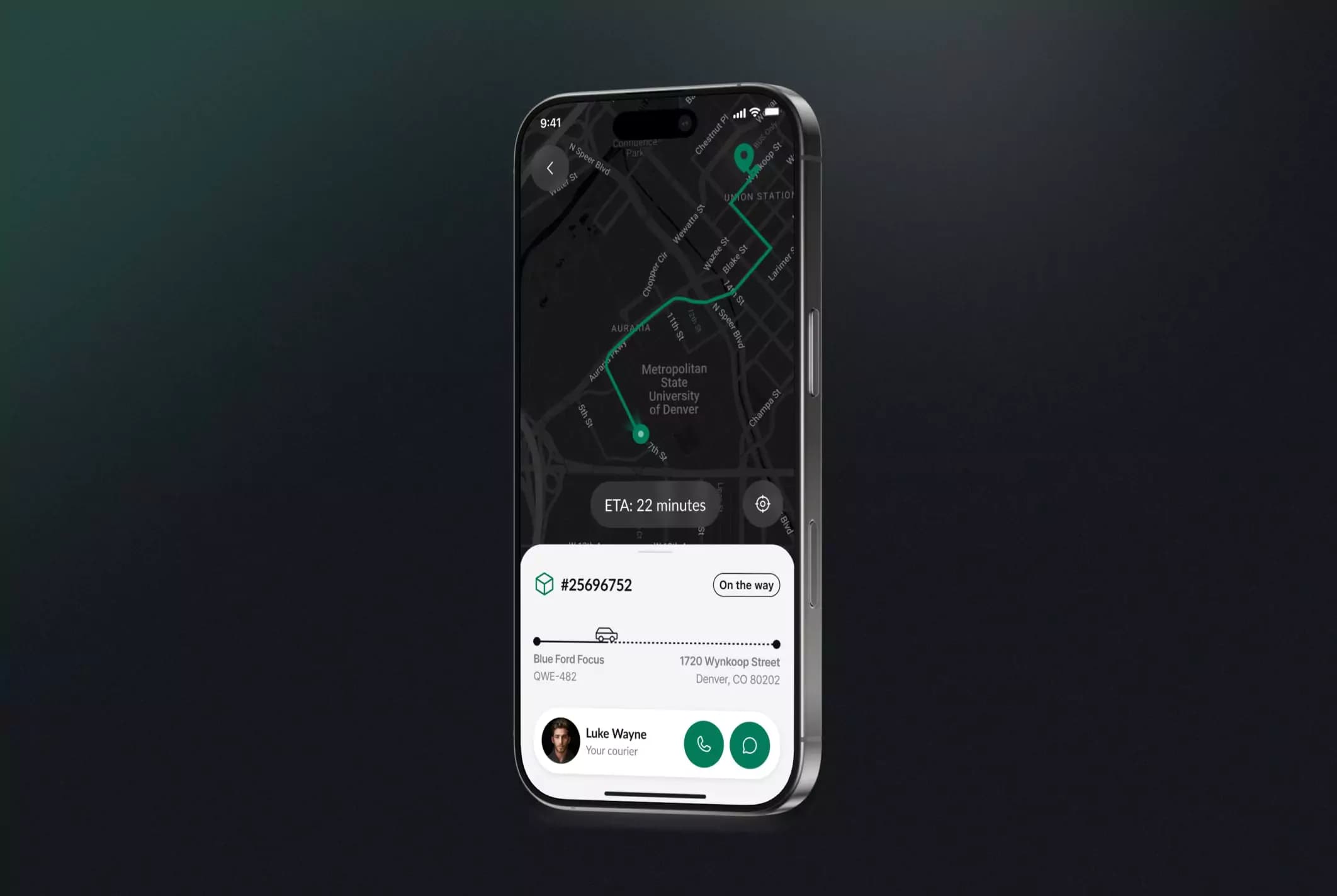
- Live Order Tracking – customers can track their delivery in real time and see the current location of the courier on the map, view delivery progress, and check estimated package arrival time.
- Delivery Status & ETA Updates – we developed a notification system allowing customers to receive all updates via SMS or email without contacting the driver or dispatcher. ETAs are calculated using a built-in AI engine and can be adjusted dynamically.
- Order Management – customers can easily review all delivery details, reschedule deliveries within the allowed SLA window and choose alternative delivery options such as leave at the door or else for even more convenience.
- Chat with Drivers – we integrated a secure chatting option to help improve coordination and minimize delivery failures. Customers can contact the driver and notify them if there are any specific instructions they need to follow.
- Proof of Delivery Access – customers can view photos of delivered packages, digital signatures and geolocation to make sure that delivery is completed.
To make FleetFlow fully customizable and suitable for B2B clients of UrbanLink, we added an option allowing users to adjust the look and feel of the tracking interface, branding for notifications, and chats.
Development Approach
To turn the client’s idea into a real product, we started with a discovery and a series of workshops to help us:
- map key user journeys for dispatchers, drivers, and customers
- discover what integrations are needed
- decide what options AI can empower and automate
The discovery ended up by creating a clear product vision, roadmap, and an AI integration strategy.
The next step was architecture creation. We designed FleetFlow as a multi-tenant SaaS platform with customization options and scalability in mind. Key architecture decisions included:
- For frontend we selected React and TypeScript to deliver fast. We also created a customizable design system to enable brand-ready theming per client. Mapbox APIs and GL JS helped us ensure interactive route visualizations.
- For mobile Driver App we used React Native for iOS and Android using a single codebase. We also selected Mapbox SDK to provide easy turn-by-turn navigation. We added a built-in barcode scanning option that enables seamless Proof-of-Delivery workflows.
- For backend our engineers selected Node.js and NestJS for a scalable, modular API layer. REST APIs were chosen to simplify integrations for real-time UIs. The selection of PostgreSQL helped to store orders, routes, and SLA metrics. Redis accelerated caching for ETAs and route optimizations. And WebSockets enabled instant status updates across the platform.
- For AI and data processing, we used Python, which helped to handle dynamic route optimization using OR-Tools, AI task auto-assignment, and risk detection based on SLA and delay patterns. We also integrated proactive risk detection, providing early warnings on SLA risks and delivery delays. AI modules were built as decoupled services, making them easier to improve, scale, or replace as models evolve.
- The infrastructure and DevOps decisions included hosting on AWS for scalability and high availability. Docker and Kubernetes (AWS EKS) we selected to orchestrate microservices. Terraform helped to automate environment provisioning. Prometheus and Grafana are allowed to monitor KPIs and SLA compliance in real time. And GitHub Actions powered a full CI/CD pipeline for rapid releases.
- UX/UI design was focused on usability and flexibility to ensure the platform would work across multiple clients. We designed an intuitive Console, mobile-first Driver App, and developed a white-label theming system. Our designers created prototypes for customer tracking experience, providing clear ETAs and proactive notifications.
- We used an Agile delivery model with bi-weekly demos. Frequent releases allowed fast validation of features and integrations. And load testing ensured stable performance under 15K+ daily deliveries. We also prepared and provided all API documentation and white-label onboarding guides for UrbanLink’s clients.
By combining user-centric design, AI-powered features, and a scalable architecture, we managed to deliver a platform that is easy to customize for diverse brands, can handle real-time delivery orchestration at scale, and automates decision-making for daily operations. This all makes FleetFlow highly competitive in the market.
Outcomes
We built and successfully launched FleetFlow which became a go-to product among the solutions of our client. The process took us 12 months, starting with discovery and development and ending with testing and launch.
The client got a scalable, feature-rich platform that can be easily adapted for multiple B2B clients and handle thousands of daily deliveries and peak seasonal loads. AI-powered modules integrated by our team empowered dynamic route optimization, predictive ETA, and automated task assignment and became key competitive advantages of the FleetFlow.
UrbanLink has already signed several contracts with logistics operators and e-commerce brands that loved FleetFlow. The business impact of its development for UrbanLink is as follows:
- Expanded product portfolio with a next-generation AI-powered platform.
- Opened new B2B sales opportunities in the 3PL/4PL and e-commerce.
- Strengthened position as an innovator in logistics technology.